1
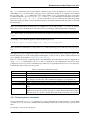
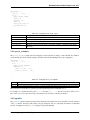
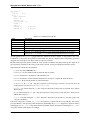
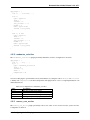
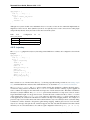
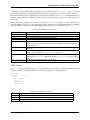
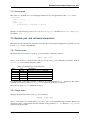
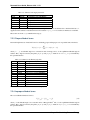
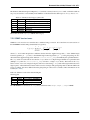
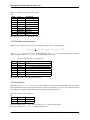
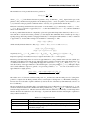
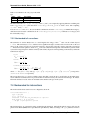
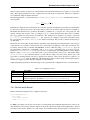
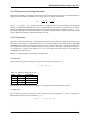
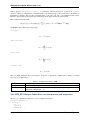
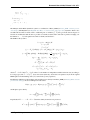
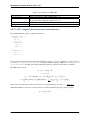
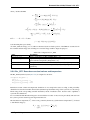
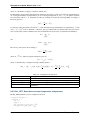
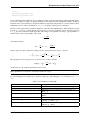
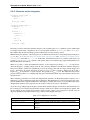
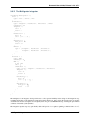
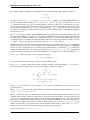
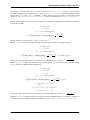
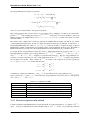
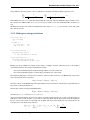
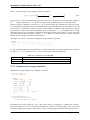
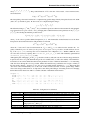
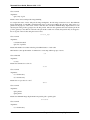
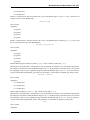
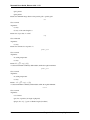
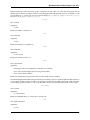
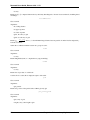
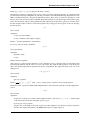
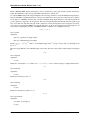
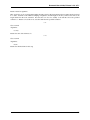
Desmond Users Guide, Release 3.4.0 / 0.7.1 This system supplies the antithetic thermostat, a thermostatting dynamics to be described in a forthcoming manuscript. It supplements the underlying Verlet dynamics described in V_NVE: Verlet constant volume and energy with a discrete thermostatting scheme. The kinetic energy K of a system with N degrees of freedom sampling the canonical ensemble with temperature T is Gamma-distributed: N , kB T K∼Γ 2 Recalling from Temperature that χ(i) denotes the thermostat which governs particle i, the kinetic energy of the particles in the j th temperature group is Kj = X i|χ(i)=j ||~ pi ||2 2mi The antithetic thermostat couples each temperature group with a stochastic thermal bath by operating on their combined energy Ej ≡ Kj + Bj where the bath energy Bj is a random variable sampled directly from the gamma distribution Nb Bj ∼ Γ , kB Tj . 2 Nb is the number of degrees of freedom of the bath specified by the user. If it is not specified, it defaults to zero, resulting in Bj = 0 and a deterministic algorithm. Let Fj (·) and Fj−1 (·) denote the cumulative distribution function (c.d.f.) and quantile function, respectively, of the Gamma distribution Nj + Nb , kB Tj Γ 2 where Nj is the number of degrees of freedom of the governed particles in temperature group j. Recall from elementary probability theory that the c.d.f. is a mapping from energies in [0, ∞) to probabilities in [0, 1). The mapping gives the probability that a random variable sampled from Γ will be less than or equal to a given energy. The quantile function is the inverse map from probabilities to energies. The effect of the antithetic thermostat is to change the total energy Ej of each energy group and its associated bath every full timestep ∆t according to: Ej0 = Fj 1 − Fj−1 (Ej ) This is accomplished by uniformly scaling the particle momenta p within each thermostat at each full timestep ∆t : s Fj 1 − Fj−1 (Ej ) 0 p~i = p~i wherej = χ(i) . Ej This system does not preserve a scalar quantity. In the absence of the NVE dynamics, the discrete antithetic dynamics would preserve the phase space density 2 X 1 X ||~ pi || Ω = exp − Ω0 k T 2m B j i j i|χ(i)=j The combined dynamics, however, does not in general preserve this density. The resulting phase space density is not easily expressed in the general case. Only when T1 = . . . = Tk = T does this system preserve the phase space density Ω = exp(−H0 (r, p)/(kB T ))Ω0 76 Chapter 9. Dynamics