1
Data-Link Modem
1. Introduction
This chapter is to familiarize the user with the operation of a modem. Note: <CR> indicates that the user must press the return
key after a command sequence.
1.1 The modem
A modem is a device that allows two terminals (DTE, PC...) to communicate via a telecommunication line (phone line).
The data is converted by the modem into electrical signals adapted to the telecommunication network. This conversion is called
modulation and demodulation.
Various conversion techniques have been developed to speed-up the data flow. The different speeds are particular to each
type of modulation: 300 bps in V21, 2400 bps in V22bis, 14400 bps in V32bis, 19200 bps in V32terbo and 33600 bps in V34.
1.2 The modem-fax
A fax device transmits scanned images via the telephone network.
In addition to traditional fax machines, the fax modem also allows transfer of computer data such as:
•= ASCII files from a text processor,
•= PCX or TIF files from a graphic editor, etc.
The Fax mode operation is controlled by a fax software which:
•= Converts files to T4 format (fax graphic format),
•= Transmits and receives faxes,
•= Supervises fax modem operation.
Supervision of the fax modem is carried out by a standard protocol: "Asynchronous Facsimile DCE Control Standard", Class 1
Service - TR 29.2188 or Class 2 Service - TR 29.2388.
The computer equipped with a fax modem will be able to transmit and receive fax in Group III mode:
•= At about one A4 page per minute,
•= In fine or standard resolution.
See chapter 5 for the list of modem class 1 and 2 commands.
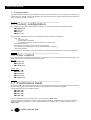
1.3 Calling modes dialing
The modem can be in 2 modes:
Send or calling,
Receive or answer.
1.3.1 Calling Mode
The modem switches to originate mode when the dial command: ATD 37487126 is sent (example number).
The calling modem then waits for the remote modem to respond.
1.3.2 Answering Mode
The modem switches to answer mode when it detects ringing on the phone line.
The answer is carried out automatically if the command ATS0 = 2 was sent to the modem by the local PC. A training sequence
is then initiated. A training sequence is the hand-shake sequence between modems to establish a communication link. It
establishes speed, modes...
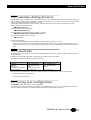
1.4 Leased line
A leased line is a permanent communication link dedicated between two modems. This kind of link is used for:
•= High usage,
•= Secure communications,
•= Privately managed networks.
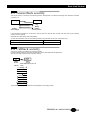
The leased line, can be a:
•= 4-Wire type where there is:
1 transmit pair,
1 receive pair.
•= 2-Wire type where:
6
SALES: 0118 965 5100