1
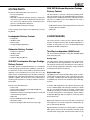
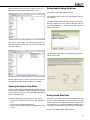
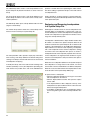
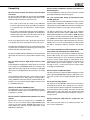
Full-bandwidth loudspeaker placement
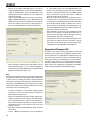
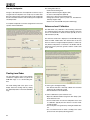
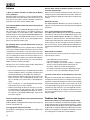
Subwoofer placement
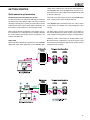
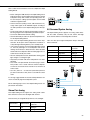
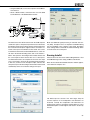
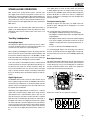
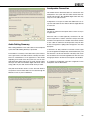
Minimum distance from a wall behind a loudspeaker
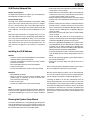
Genelec two-way DSP loudspeakers (8240A and 8250A) should
be placed so that a minimum distance of 5 cm (2”) is left behind
the loudspeaker for amplifier cooling and rear opening reflex port
sound radiation.
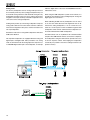
Subwoofers can make life much easier in producing high quality low frequency reproduction. When a subwoofer is used, the
loudspeakers can be placed more freely, thereby allowing more
flexibility in finding a good location in the room for the reproduction of low frequencies.
Low frequency cancellations
In general, when a loudspeaker’s front baffle is more than 0,3
meters (1 foot) away from the wall behind the loudspeaker, a reflection from this wall can cause a cancellation of low frequencies
and hence reduction of bass output. For two-way loudspeakers,
low frequency cancellations in the 40 – 80 Hz frequency range
should be avoided. Cancellations in the 80 - 200 Hz range should
also be avoided if possible.
A subwoofer should be placed close to a wall, preferably closer
than 0.6 meters (2 ft.) from a wall. This eliminates most possible
cancellation sources and the subwoofer response remains flat
and well loaded.
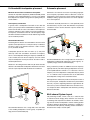
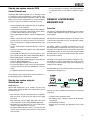
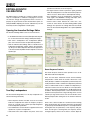
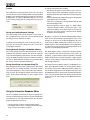
Recommended distances
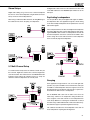
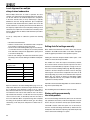
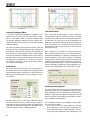
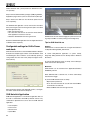
Translating this into distance recommendations shows that loudspeakers can be placed close to a wall (see above) at a distance
less than 1 meter (3 ft.). Distances between 1 and 2.2 meters
(3-7 ft.) should be avoided.
Loudspeakers placed more than 2.2 meters (7 ft.) away from
walls may suffer from cancellations around the low frequency
cut-off of the loudspeaker limiting low frequency bandwidth. As
a rule of thumb, the lower the low frequency cut-off the further
away the loudspeaker must be placed from the wall in order to
avoid this phenomenon.
Distances to the ceiling and other walls may be shorter than the
distance to the wall behind a loudspeaker. Reflections from these
surfaces may be important and should also be considered.
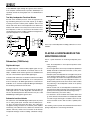
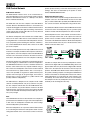
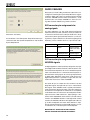
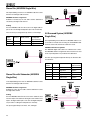
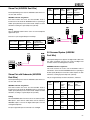
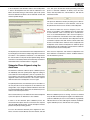
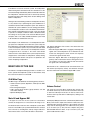
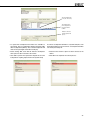
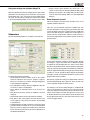
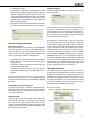
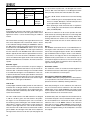
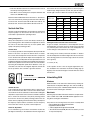
Recommended distances from a single wall to the front baffle of
loudspeakers combined with subwoofer(s). Correct (green), acceptable (orange) and not recommended (red).
Using a subwoofer provides an additional crossover frequency
(typically at 85 Hz). This makes placing loudspeakers much easier. Acceptable distances extend to 1.1 m because of the low
frequency cut-off of loudspeakers. Loudspeakers may be placed
1.1…2 m without serious compromises due to the wall behind
the loudspeaker causing serious cancellation effects.
Although Genelec subwoofers provide accurate phase control at
the crossover point, loudspeakers should not be placed further
than 2 m (7 ft.) from a supporting subwoofer. Larger distance differences may cause tonal balance differences around the crossover frequencies due to loudspeakers and subwoofer(s) exciting
different room modes.
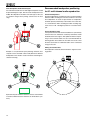
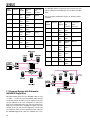
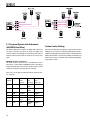
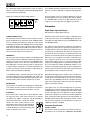
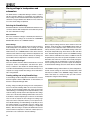
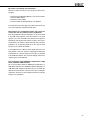
Multi-channel System Layout
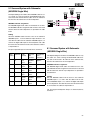
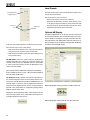
Recommended distances from a single wall to the front baffle
of free-standing loudspeakers. Correct (green), acceptable (orange) and not recommended (red).
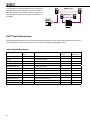
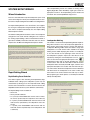
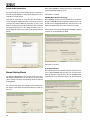
The positioning of tables, screens, racks, etc, is critical in order
to maintain accurate imaging. Early reflections can smear the
sound image and compromise localization. To avoid this, reflecting surfaces between loudspeakers and the listening position
should be minimized. Symmetrical positioning of equipment is
essential. Even with symmetry, reflecting surfaces should be removed from the vicinity of acoustic paths.
13