1
Enea OSE Systems
So maybe one block of transient cache is
sufficient to map the interrupt handler into
without loosing too much performance.
2YHUODSSLQJUHJLRQV
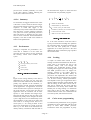
The transient region can overlap the normal
region, i.e. the transient ceiling can be
“beneath” the normal floor. This will result in
a region more frequently “visited” by a
pointer, either the pointer of the normal region
or the pointer of the transient region. The data
being mapped there will have a shorter life
span then anywhere else in the cache. The only
way to control what data will put into this
normal/transient region is to have all blocks
belonging to the transient region also belong to
the normal region, i.e. the transient region is a
subset of the normal region. So what could this
region be used for? Well, it’s useful if the
programmer knows the entire cache will be
used but some parts of the code (like interrupt
handling) that can occur at any time should not
be able to mess up the cache entries too much.
Then the number of blocks allowed to be used
by this temporary function can be reduced to
just a subset of the normal blocks leaving the
rest unaffected.
/RFNLQJ
Using the transient region to reduce the
interrupt latency is not really recommended. If
the entire interrupt handler does not fit in the
transient region the resulting misses due to the
round-robin replacement scheme is high. Even
if the replacement algorithm had been LRU it
wouldn’t be much point because of the linear
behavior of the interrupt handler (few loops,
and branches). On the other hand the transient
region can be used for reducing the number of
blocks being replaced as a result of an interrupt
by having a small transient region and map the
interrupt handler to the transient region. If not
to waste cache memory the transient region
should be a subset of the normal region giving
the interrupt handling fewer blocks in the
normal cache to play with when dealing with
an interrupt.
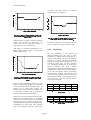
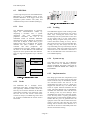
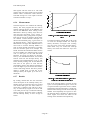
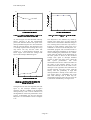
The 440GP also support locking. Given the
high set set-associativety the problems with
locking are less complex. Locking one or a
couple of ways gives less slowdown to other
parts of the code sharing that set. Since a set
can have up to 128 ways in 440GP locking will
give a more linear slowdown, locking 10% of
the cache resulting in 10% slow-down. In a
processor with low set-associativety, like the
MPC860 with only 2-way set-associativety
locking one way means that the rest of the
code sharing the same set as the locked block
will se a direct-mapped cache. Locking both
ways in the same set and no cache will be
available and the block will have to be read
from a buffer. The pretty big size also helps
out; the 440GP having 32kB instruction cache
alone and the MPC860 “only” 4-kB instruction
cache.
already concluded that locking can improve
the interrupt latency in both the MPC860 and
MPC8260 we can safely assume that the case
is the same with the 440GP. Compared to the
other processors the biggest gain will probably
be in that the rest of the system will run faster.
Larger caches will mean that less percentage of
the cache is locked and the high setassociativity resulting in that locking one way
doesn’t matter that much to memory positions
sharing the same set.
&RQFOXVLRQ
Will the high set-associativity and the large
amount of cache result in a lower latency for
interrupt handling? Giving the fact that we
2WKHUDUFKLWHFWXUHV
PowerPC is one of the key-platforms
supported by OSE’s delta kernel. Other
architectures supported are m68k, MIPS and
ARM. The ARM processor targets portable
solutions and is focused on low power
consumption. ARM is actually a company and
licenses its RISC architecture to other
companies that manufacture the processors
(Intel, IBM). The ARM740T has a 4-way set
associative write-through unified 8K-byte
cache that supports locking. It would have
been nice to test the performance of cache
locking on that processor since a smaller
unified cache because of locking also affects
the performance on load and store operations.
Also the processor has a different replacement
scheme, it uses random replacement. The
locking of the cache is done the same way as
in the MPC8260. The programmer can lock
one to three of the four ways. The cache only
being 8K-bytes big has a major impact if one
of the ways is locked. The best thing of the
ARM740T compared to the MPC8260 is that
the ARM processor has explicit loading
functions to load instructions into the cache.
The same speedup should be possible with the
- Page 33 -