1
Enea OSE Systems
system can be either SUHHPSWLYH or QRQ SUH
HPSWLYH. In a non pre-emptive system once a
task has started it will execute until it is
finished. In a pre-emptive system a task can at
any given time be pre-empted and the
processor assigned to another task. The
scheduling mechanism in a system can be
either VWDWLF or G\QDPLF. Static scheduling will
determine the order in which processes will
run prior to their execution based on fixed
parameters known in advance. When using
dynamic scheduling the decisions are made
depending on dynamic parameters that can
change during run-time. A similar division
exists between online and offline scheduling.
When using online scheduling decisions are
made each time a new task arrives to the
system while using offline scheduling the
decisions are made on the entire task set prior
to execution. A scheduling algorithm
managing in finding the minimal cost over a
set of tasks is called RSWLPDO. The cost is not
necessarily measured in execution time but can
be the resource usage or something else. An
algorithm is called KHXULVWLF if it tends to find
the optimal way but does not guarantee it.
In hard real-time systems the scheduling needs
to be guarantee-based. If the system is static
then advanced algorithms can be used to find
the most optimal execution path but this tends
to make the system very inflexible. In dynamic
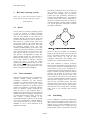
systems the scheduling needs to be done online; each time a new task arrives to the system
the scheduler must determine if the task can be
scheduled and if all previous timing constraints
still can be kept. If the scheduler determines it
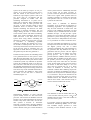
cannot guarantee the deadline it must signal
the owner of the task that it cannot be
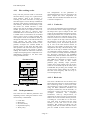
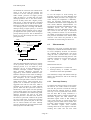
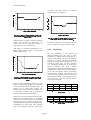
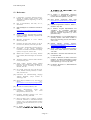
scheduled, Figure 3.2.
Scheduling
Activation
Accept
Acceptence
test
Reject
Termi nation
Ready
Signal free
resource
Run
Preemption
Waiti ng
of the system resources. Additionally the tasks
in the system can be either DSHULRGLF or
SHULRGLF. Tasks are aperiodic if their activation
times aren’t regular while periodic tasks are
regularly activated at a constant rate. Periodic
and aperiodic tasks can co-exist in the same
system at the same time.
There exists a multitude of different
algorithms. A lot of research is being done on
scheduling algorithms. Just explaining how
they all work would fill a whole book. The
purpose of all scheduling algorithms is to find
a feasible way to schedule all tasks so all their
deadlines are kept. So lets just take a quick
glimpse at a few common algorithms. They all
presume a system consisting only of periodic
tasks, which all are independent of each other;
i.e. no precedence or resource constraints exist.
The most straightforward method is to assign
fixed priorities to all tasks and let the task with
the highest priority run; this is called
preference-scheduling (PS). This method gives
no guarantees that any deadlines are kept. It
guarantees that the process with the highest
priority is allowed to run before any lower
priority process. For a system with only
periodic tasks the scheduler must for process 3
guarantee that its deadline will be kept even if
all periodic processes with higher priorities
become ready at the same time as 3 becomes
ready. All the higher priority processes will be
run before 3 and when finally it’s 3’s turn
there must be enough time for 3 to finish
before its deadline. A necessary but not
sufficient condition that scheduling of periodic
processes is feasible (all deadlines are kept) is
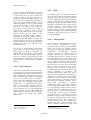
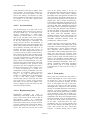
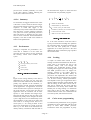
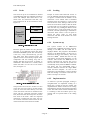
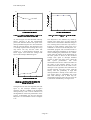
that the sum of all processes utilization, Figure
3.3, is less then 1. The process utilization is the
fraction of processor time spent in a process
deadline interval. The deadline interval is the
interval from which a task becomes ready to
when it must be finished with its task.
Wait on busy
resource
8
= ∑ =1
" ! ! Guaranteeing deadlines in hard real-time
systems usually results in a low load on the
processor. This because all deadlines still must
be kept even at peak-load (When all processes
become ready at the same time). In soft realtime systems a KHXULVWLF or best-effort
approach is usually better. Keeping deadlines
is still important but a missed deadline won’t
result in disaster. This gives a better utilization
(
,QW
<1
" " The utilization 8 must be smaller than one, ( is the execution time for process L, ,QW is the
deadline interval and n is the total number of
processes in the system.
For periodic systems an algorithm called Rate
Monotonic Scheduling (RMS) can be used.
The scheduler assigns priorities to tasks
according to their deadline intervals. A low
- Page 4 -