1
Chapter 1: Building Resources
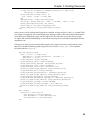
:instruction => “”, :unit => “”, :amount => 0)
parser = IngredientParser.new(str, result)
parser.parse
end
Finally, the display_string method of Ingredient makes sure everything is in a standard format
as follows:
def display_string
str = [amount_as_fraction, unit_inflected,
ingredient_inflected].compact.join(“ “)
str += “, #{instruction}” unless instruction.blank?
str
end
The compact.join(““) construct gets rid of the unit if the unit is not set, and does so without putting
an extra space in the output. The amount_as_fraction method converts the decimal amount to a
fraction, matching the typical usage of cookbooks. (Although this may later be subject to localization,
because metric cookbooks generally don’t use fractions.) The inflected methods just ensure that the units
and ingredients are the proper singular or plural case to match the amount — because “1 cups carrots”
will just make the site look stupid.
Adding a Coat of Paint
At this point, I went to www.freewebtemplates.com and chose the canvass template, also available at
www.freecsstemplates.org/preview/canvass. I wanted to spruce up the look of the site with
something clean that didn’t look like Generic Boring Business Site. The free templates on this site are
generally licensed via Creative Commons (although if you use one, check the download to make sure).
It’s a good place to get ideas and to see how various CSS effects can be managed. Naturally, if you were
doing a real commercial site, you’d probably want something more unique and original.
Integrating the template was straightforward. The template download has an HTML file, a CSS file, and
a bunch of image files. I copied the image files into the application’s public/images directory, and then
took the CSS file and copied the entries into the preexisting public/scaffold.css file. Alternately,
I could have just copied the entire file and added a link to it in the layout. Then I copied the body
elements from the provided HTML file into the app/layouts/recipes.html.erb file so that the main
content in the provided file was replaced by the <%= yield => call that will tell Rails to include the
content for the action. I also tweaked the text somewhat to make it work for Soups OnLine. Finally, I had
to go back into the CSS file and change the relative references to image files (images/img01.gif) to
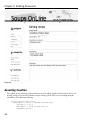
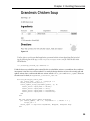
absolute references (/images/img01.gif), so that they would be correctly found. The finished result is
shown in Figure 1-2. The final layout and CSS files are a bit long and off-point to be included in the text
here, but are available as part of the downloadable source code for this book.
29