1
Report. No. S’I’AN-CS-N-883
On Program Transformations for Abstract
Data Types and Concurrency
bY
I’. I’cppcr
Department of Computer Science
On
Program Transformations
for
Abstract Data Types
and Concurrency
bY
P. Pepper
Cornpu tcr Science Depar trnent
Stanford University
Stanford, Ca 94305
Abstract
W C study transformation rules for a particular class of abstract data types, namely types that are
rcprcscntablc by rccursivc mode declarations. ‘I‘hc transformations arc tailored t,o the dcvclopment
of cflicicnt tree traversal autl they allow for concurrency. The tcchniqucs a r c exctrrrplificd b y a n
implcrncntxtion of concurrcut insertion and dolction in 2-3-trees.
1.
DATATYPES,TRANSFORMATIOSAND
CO N C U R R E N C Y
The purpose of this study is threefold: We seek transformations for data structures. We want these
transformations to allow for concurrency. And we want to apply them to a nontrivial example,
viz. concurrent operations on data bases. We do not talk here about notations for transformations
nor do we discuss their automatic application. And we avoid detailed semantical considerations
(which are replaced by references to the pertinent literature).
Program transformations shall capture frequently employed programming techniques _ be they
newly invented or taken from the literature - into a schematic form that allows a fairly easy
application to concrete problems. It usually does not make sense to aspire to rules that are
applicable to any program ‘. One rather has to concentrate on special classes of programs to achieve
reasonably powerful and flexible transformations (e.g. recursion removal, loop optimization, etc.).
For this reason we focus on the particular class of those data structures which are defined by
recursive mode declaraiions. The transformations presented include the derivation of traversal
operations and of pointer implementations.
Concurrency is viewed here as an optimization issue rather than as an inherent property of the
given problem. This view is certainly admissible when the concurrency comes into existence b y
allowing several processes to execute a known sequential task simultaneously. In this case it is also
appropriate to work with the so-called multiprogramming assumplion, i.e. to semantically model
parallelism as sequential in&leaving of atomic actions.
Data base operations such as insertion, removal and search me& the above
operations are well-known in sequential applications and they are now to
concurrent environments. For the implementation of data bases one frequently
for example the B-trees suggested in [4]. To shorten the writing-down we will
the special case of 2-3-trees (cf. [l]).
requirements. These
be transferred into
uses tree structures,
restrict ourselves to
The paper has two major parts. Section 3 lists a number of transformations for recursive data
structures. These transformations essentially capture standard programming techniques within the
formalism of abstract data types and also make an attempt to cope with concurrency and protection
problems. The U S C of abstract data types leads to a valuable accuracy of the specifications. But
one has to pay a price, viz. an increased length of code. (This makes the generation of abstract
hata types by transformations even more desirable.) Even if we restrict our attention to the class
of recursive type declarations there remains a vast abundance of conceivable transformations. The
choice made in this paper is primarily motivated by the intended sample development. But, vice
versa! the design of the algorithm is also influenced by observations about the available rules an interesting feedback between transformations and decision making on the programmer’s side.
Section 4 contains a development of t,hc operations insert and remove for 2-3-trees, allowing for
concurrency. ‘IIIC\ algorithrn differs somewhat from the one given in [‘I] and its improved version
in [II]. This difference may be roughly described as follows: LB-trees as well as their special case
2-3-trees have two charac tcrisitc proper ties, viz. the special tree structure, which is responsible
for the correctness of all operations, and the balancing (all paths have the same length), which is
responsible for the efficiency. The operations insert and remove at least temporarily violate these
properties. In [4] the decision was to violate the particular tree structure and to keep the balancing
intact. WC feel, however, that the correctness issue deserves precedence and therefore keep the
‘Well, compilers arc an exception.
tree structure intact while tolerating a temporary disturbance of the balancing. As a consequence,
locks are only needed for a very few nodes at a time and reading as well as writing operations may
almost unrestrictedly coexist in the same (sub)trees.
There is one severe problem: Transformations ought to be “correct”. But any notion of correctness
is vain without a precise semantical definition of the language under consideration. Our topics here
are abstract data types and concurrency, both issues that are currently attacked (with varying
success) in an abundance of articles. It clearly is far beyond the scope of this paper to discuss two
such heavy problems incidentally. We will therefore nolens volens rely on a more intuitive idea
of the correctness of transformations. The focus of our attention will be the technical feasibility
and the usability of the rules, assuming that they are semantically justified. (It will only be in the
appendix that we try to at least sketch the underlying semantic modelling.)
2 . TH E B A S I C P R O B L E M
The problem domain we have chosen allows a clear partitioning into two subtasks: The operations
to be performed on the given data structure are specified completely independently from any concurrency considerations. The parallelism comes in by simply allowing several sequential processes
to operate on the common data structure simultaneously. The situation is therefore characterized
by the fact that the the processes communicate for no other reason but protection against mutual
interferences.
2.1.
THE D ATA T YPE
DICTIONARY
In a very abstract form, data bases may be thought of as sets on which the basic operations “insert
a n element”, “find an element” and “remove an clement” can be performed. These operations are
formally specified by the following abstract data type D I C T I O N A R Y (as it is termed in [I]). The
notation will be explained below.
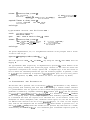
type
a
DICTIONARY
(type ELEM)
declares set,insert,remove,member :
based on: ELEM, BOOL
sorts:
set
opns:
axioms:
elem
set X elem
set X elem
set X elem
Vset s, elem x,y :
empty :
insert :
remove :
member :
--+
--+
-+
+
set
set
set
boo1
= false
member (empty, y)
member(insert(s, x),y) = true
= member (s, y)
remove(insert(s,x),y)
= remove(s,y)
= insert (remove (s, y), x)
required: Velem x :
s # empty
for
remove( s, x)
end of type
3
if x=y
otherwise
i f x=y
otherwise
The notation used here is a syntactically sugared mixture of those found in [7] and [IS]: T h e
parametrization takes into account that sets can be defined for any type of elements. As suggested
by the keyword declares 2 a number of identifiers are provided to the environment; all functions not
listed here are “hidden”. (Thus the operation e m p t y is hidden. Actually, without this operation
it is impossible to generate an initial set for further use. B u t w e assume t h a t t h e r e i s s o m e
mechanism such as the ADA package initialization,’ which is of no concern to us here. W C d e a l
only with processes that are allowed to use the remaining operations on an existing set.) The type
is based on two other types, viz. the parameter ELEM and B O O L , and it introduces a new sort
of objects, called sets. The list of operation symbols together with their functionalities completes
the “syntactic interface”.
The axioms, a set of universally quantified conditional equations, specify the behavior of the
operations and objects defined by the type. The requirements play a particular role: It is understood
that all other equations only hold if none of the requirements is violated (“implicit condition”). In
the literature one finds essentially two ways of handling partially defined functions such as r e m o v e .
One is to introduce special error-elements. In this setting we would write
V set s, elem x : remove(s, x) = error
if
s = empty.
Alternatively, one may work with partial algebras, which leads to notations such as
if
V set s, elem x : undefined(remove (s, x))
s = empty,
or equivalently
Vset s, elem x : s # empty
if
defined( remove (s, x)).
For some of the applications in this paper the last form will be the most convenient one for
expressing the restriction of the domain of a function. To stress this particular usage we employ
the special n o t a t i o n2
V s e t s , elemx:sZempty
for
remove (s, x).
From our practical point of view we need not care about the two (theoretically quite different)
possible interpretations of partially defined functions.
1-n later examples we will use some further constructs. The expression enrich.. . b y instead of
based on.. . means that we only add new operations to the type, but that these operations do
not generate further objects. As pointed out by Burstall and Goguen (cf. [7]) this allows the u s e
of, say, existential quantifiers in enrichments. Finally, the expression A @ B builds the “disjoint
union? of the types A and B except that common subtypes are not duplicated.
According to the principles described in [IS] or [5] any model of this data type is acceptable as
an irnpl~rncnt;ltion. Though never making explicit U S C of it W C will orient our whole development
t o w a r d s t,hc so-called “ t e r m i n a l rnodcl”. Without going into any theoretical details this model
may be roughly characterized by the following definition of the equality of its objects. The only
way to distinguish two sets “from the outside” is by checking their elements using the operation
member. This means that two sets s and s’ are “indistinguishable” or “visibly equivalent” if
for all x the equality member (s, x) = member (s’, x) holds. When applying this criterium to tree
implementations we have to consider two trees as being equivalent if they have the same leaves
(even though they may exhibit completely different internal structures).
_*Specification languages exhibit a tendency towards colloquialism.
4
2.2. C O N C U R R E N C Y
The second major aspect of our task is concurrency: There
above operations on the given set simultaneously. For the
mutual interferences when accessing the common set s we
operation r-lock (s) sets a read-lock on the variable s and the
are several processes performing the
protection of these processes against
employ a locking mechanism. T h e
operation w-lock (s) sets a write-lock.
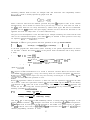
Our prograrn consists of n processes executing set operations of the kind
II . . . I p p ::
...
...
r-lock(s); b := member(s, x); r-unlock (s);
...
IIP, ::
. . . w-lock(s); s := insert(s, x); w-unlock(s);
...
1 . . . 1]
In the above specification of the concurrent processes and their interaction the operations i n s e r t ,
r e m o v e a n d m e m b e r are taken to be “atomic”. This is, of course, unrealistic and therefore the
goal of the subsequent prograrn devclopmcnt will be to increase the degree of concurrency by
irnplcmenting these. operations in terms of more elementary ones.
3 . T E C H N I Q U E S,
T OOLS AND
TRANSFORMAWONS
The underlying idea of program transformation is to capture repeatedly occurring programming
techniques in schematic rules such that it becomes fairly easy to apply these techniques to concrete
problems. For classical language constructs (recursive functions, loops, assignments etc.) pairs of
program schemata have already proved good (cf. e.g [t;]), 1)u t in connection with data s t r u c t u r e s
and their operations the task becomes more complex. W e will try here to attack the issue within
the framework of abstract data types.
d
Systems such as CLEAR or OESJ (cf. [7], [s]) p rovide valuable tools for modularizing a development
process and for describing relationships between various types. (In addition they arc based on
a s o u n d m a t h e m a t i c a l ?hcory.) IIowever, the systems of types are still “static”, i.e. fixed u p o n
writing-down. A stepwisc program development process also needs a dynamic component, i.e. tools
_ for altering given type systems. Transformations arc such a dynamic tool. W C are not attempting
-to cast the trxnsl’ormations presented in this chapter into a formal notation. The paper s h o u l d
rather be seen as a test whether the development of such a formalism seems worthwhile.
W C try here to identify those transformations that arc needed to a c h i e v e a particular goal, viz.
tree operations that can d o without exhaustive search. Therefore we develop specialized abstract
data types that contain just the properties W C need. These properties are found by analysing
algorithms known from the literature and by separating their essential characterisitics from minor
particularities.
5
3.1. R
ECURSIVE
TYPE D
ECLARATIONS
There is a particular class of abstract data types that are both easily understood and frequently
occurring in applications. In fact, due to their simplicity these types are usually written in the
shorter notation of recursive mode declarations. A classical example are binary trees:
type tree = leaf (elem item ) 1 cons (tree son1 , tree son2)
This can be viewed as a shorthand notation for a type T R E E that introduces in addition to the
operations leaf, item, cons, son1 and s o n 2 with their obvious axioms also the test functions
. is leaf and . is cons (cf.[3]).
I3ccausc of its shortness we will from now on work with this example, but it should be understood
that the techniques apply to any type that is defined by such a recursive declaration involving
direct product and direct sum. In this sense the subsequent sections should be seen as presenting
rules that apply to arbitrary recursively delined data types.
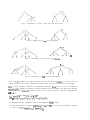
A note of caution: If a tree contains two identical subtrecs the spccilication allows implementations
according to either of the following figures:
So one has to be careful when applying arguments that intuitively refer to the left model. The
subsequent considerations work for both cases, but in general it is recommendable to U S C t r e e s
without multiple subtrecs.
We are aiming at, a particular class of algorithms, namely those that traverse trees efficiently
without the need for cxhaustivc searches such as depth-first or breadth-lirst s e a r c h . T h e r e f o r e
we assume that there exists a predicate P that determines for any given tree whether tho search
should continue in the lelt or in the right son. (This special case is the one we are interested in
and for which we therefore formulate a transformation.) To express this special goal we introduce
an enrichment of the type TREE that reflects the property that P is true for exactly one son if it
is true for the father.
type
PTREE
declares P :
enrich
TREE b y
opns:
P:
t r e e -+
boo1
required: Vtree t, :
P(son1 (t)) V P(son2 (t))
P(son1 (t)) A P(son2(t))
end of type
if
if
t is cons A P(t) = true
t is cons r\ P(t) == true
The generation of this type could be done automatically by some of the later transformations. But
the presentation is more straightforward if we do it right here, for this indicates that the whole
development relies on the existence of such a P.
3.2. SUBTREES
SUBSTITUTION
AND
Basic notions for trees are the predicate “is subtree of” and the operation “within t substitute s by
u”. For easier readability we will use the infix notations s f t for the subtree relation and t[s += u]
for the substitution operation. Both can be defined by a simple data type extension. (Note that
substitute replaces all occurrences of s within t and that the restriction for the substitution is
induced by the type P T R E E. )
type
TREE+
declares
enrich
PTREE
opns:
, +.:
. [T=- .] :
axioms:
Vtrees,t,u:
. f., .[A=.]:
by
tree X tree
tree X tree X tree
-+
-+
if s=t
if tis c o n s
otherwise
s f
- t = true
= true
= false
A
boo1
tree
( s fsonl(t) v s tson2(t))
t[s 4== u] = u
= cons( sonl(t)[s e= u] , son2(t)[s + u] )
= t
required: Vtreet,u:
if t=s
i f tZs/1tiscons
otherwise
for t[t G u]
p(t) * p(u)
end of type
Now assume that we have operations that transform trees into trees. As a running example we
will use the addition of a leaf.
type
TREE1
declares
add :
enrich
PTREE
opns:
add :
axioms:
V tree s, elem y :
by
tree X elem -+
add(s,y) = s
= cons (s, leaf(y))
required: V tree s, elem y :
s is leaf
end of type
for
add (s, y)
tree
if item (s) = y
otherwise
The leaf to which the operation a d d shall be applied is in general contained in some enclosing
tree. Therefore we need an extension Add that applies a d d to a suitable subtrce of a large given
tree. The problem here lies in the word “suitable”.. Since the restrictions above do not determine
an admissible subtree uniquely we have to make a choice. Making choices means to introduce
nondeterminism. Within the classical framework of abstract data types the only way of doing
this is by way of disjunctions and existential quantifiers. (For more details see appendix A.) The
following type therefore specifies that the addition should take place at any subtree s of t which
is a leaf. (Note: If s occurs several times in t the new leaf is added several times; but in our
aforementioned equivalence relation this does not matter.)
type EXTENDED
enrich
TREE+
opns:
Add :
axioms:
declares Add :
TREE
CB
TREE1
by
tree X elem -+
tree
V tree t, elem y, 3 tree s :
s 3 t
A
s is leaf
A
Add(t, y) = t[s e add(s, y)]
end of type
This type illustrates a typical aspect of transformation systems. Certain rules are designed in
a relatively complicated fashion to ensure correctness in any case. I3ut they will only effect
improvements when applied to programs exhibiting special properties. In our case this means that
the above transformation is best applied in those cases where the restrictions of the type T R E E 1
determine the subtrce uniquely.
Transformation: The transformation has the form M A K E - E X T E N D E D - T R E E ( T R E E , T R E E l ) ,
w h e r e T R E E refers to (some enrichment of) a recursive type and TREES specifies the special
operations such as a d d . The result is a type of the kind E X T E N D E D T R E E.
The transformation is indeed mechanically performable, since all parts of the equations are syntactically dcrivablc from the given types. In particular, the condition in the type E X T E N D E D T R E E
is just the requirement for the operation a d d , i.e. the substitution is applied at some permissible
point.
If we make corresponding enrichments for deletion and membership test (see section 4) this type
provides an implementation for the type D I C T I O N A R Y. To show this one needs an cquivalcnce
relation on trees (cf. [5]). The appropriate one here is: Two trees tl and t2 are equivalent if they
have the sarne set of leaves. (The internal structure of the trees as well as the multitude of leaves
are neglected.) Using this relation we could prove that all axioms of the type D I C T I O N A R Y a r e
fullillcd by the implerncntation. As a rn;-lttcr of fact, the resulting model is the terminal one, since
the equivalence coincides with the visible equivalence of D I C T I O N A R Y .
This will be the only point in a program development along the lines described here, where one
needs proofs on a meta-level (employing equivalence relations, homomorphisms and the like). From
then on the development can make U S C of the transformations to be presented below.
3 . 3 . TR E E T R A V E R S A L
Though being very convenient for specification purposes - e.g. for the proof that the t y p e
E XT EN DE D TREE is an implementation of the type D I C T I O N A R Y - the above notion of “subtree”
does not indicate how the subtrcc may be localized in an cfhcient way. To get a more operational
specificat,ion that describes “tree traversal” we introduce the idea of a “current node” into our types.
(We will use the terms “current node” and “current (sub)trec” synonymously.) Conceptually this
may be specified by a pair of two trees one of which is a subtree of the other.
T h e p r e d i c a t e P introduced in the type P T R E E of section 3.1 is now used to direct the search
through the tree. For this reason the subsequent type is based on P T R E E.
type
enrich
T RAVERSABLE
PTREE
TREE
d e c l a r e s t t r e e , r e s e t , d o w n , u p ,current :
by
ttree
ttree
ttree
ttree
tree
tree
tree
--+
t t r e e --+
t t r e e -+
ttree -+
t t r e e -+
t t r e e -+
V ttree tt, tree s :
init :
reset :
down :
.
up :
root :
current :
root(init(s))
=
s
root(reset(tt))
= root(tt)
root(down (tt))
= root(tt)
root(up(tt))
= root(tt)
current (reset (tt)) = root (tt)
current (down (tt)) = son ;(current(tt))
up (down (tt))
i f P(soni(current ( t t ) ) ) = true
= tt
required: V ttree tt :
current (tt) 5 root(tt)
P(current (tt)) = true
current (tt) # root (tt)
l(current (tt) is leaf)
f o r up(tt)
for d o w n ( t t )
end of type
Note that the operations init and root are hidden, i.e. any process working with the type can only
use the operations reset etc. (As in the type D I C T I O N A R Y we assume some kind of initialization
mechanism.) The operation up is only specified as being the inverse of d o w n . Note also that the
first two requirements hold by construction. Hut they will become important in a later extension.
A s a straightforward extension we now add the operation %ubstitute” in such a way that it is
automatically applied to the current subtree.
t y p e TRAVERSABLETREE+
enrich
TRAVERSABLETREE
opns:
subst :
declares subst :
(33
TREE+
ttree X tree -+
ttrce
by
9
axioms:
V ttree tt, tree s :
= root(tt)[ current += s]
root(subst(tt, s))
current(subst(tt, s)) = s
required: V ttree tt, tree s :
P(s) = true
for
su bst (tt, s)
end of type
The requirement is enforced by the type T R A V E R S A B L E
invariantly true for the current subtree.
T R E E:
The predicate P has to be
T r a n s f o r m a t i o n : In the transformation MAKE-TRAVERSABLE-TREE(TREE,P) the parameter
again refers to (some enrichment of) a recursively defined type and P is the predicate
for directing the search. The result of the transformation is the type T R A V E R S A B L E T R E E+
(including the type P T R E E , which may be automatically generated here).
TREE
Note that the only references to the underlying recursive type are the use of son; and the predicate
isleaf in the specification of d o w n . Therefore the transformation is indeed mechanically executable.
3.4. I M P L E M E N T I N G
S UBSTITUION
BY
T REE T R A V E R S A L
T h e t y p e E X T E N D E D T R E E u s e s a c o m p l e x s u b s t i t u t i o n o p e r a t i o n t h a t a p p l i e s t o a l l subtrees
having a certain property. The purpose of tree traversal is to localize such subtrees, i.e. to make
ihcm into current trees. If no further information exists this traversal has to follow a depth-first
search or a breadth-first search strategy. We will, however, formulate a transformation for the
case where the subtree can be uniquely determined using the predicate P mentioned in section 3.3.
In section 3.2 we have enriched the basic type TREE by special operations such as a d d . A s
an intermediate step we do the same enrichment for traversable trees, now applying the operat i o n t o t h e c u r r e n t subtree. Hence, t h e n e w o p e r a t i o n s h a l l h a v e the property add’(tt, y ) =
su bst (tt, add (current (tt), y)), which according to the definition of the original a d d leads to the
specification3
,tYPe
TRAVERSABLE
TREE1
enrich
TRAVERSABLETREE
opns:
add :
axioms:
V ttree tt, elem y :
declares add :
by
ttree X elem +
ttree
add(tt,y) = tt
= subst(tt , cons (current (tt), leaf(y)) )
if item (current(M)) = y
otherwise
required: V ttree tt, elem y :
current (tt) is leaf
for
add (tt, y)
end of type
The following type combines the above substitution with the tree traversal that finds a suitable
subtree. (Note that the predicate P is part of the definition of d o w n .)
3The use of the same identifier does no harm since the e n v i r o n m e n t a l w a y s tiistinguishcs them.
10
type
EXTENDED
enrich
TRAVERSABLE
TREE
opns:
TRAVERSABLETREE b y
Add : ttree X elem -+
axioms:
V ttree tt, elem y :
declares Add :
Add (tt, y) = Add (down (tt), y)
Add (tt, y) = add (tt, y)
if -( current is leaf )
if current is l e a f
end of type
It is clear how in a procedural version of the program the function Add would become a simple loop.
The important question is, however, under which conditions the above operation A d d i m p l e m e n t s
the one in section 3.2 (where implementation means that it yields one of the results contained
in the nondeterministic choice). In other words, when does the predicate P lead to a subtree s
compatible with the restrictions for add in the type TREEI?
Let R(s) st,and for the restriction, in our case R(s) =“s is l e a f ” . Then the applicability condition
for the transformation is
v’t: P(son i(t)) A (3
S:S ftAR(s))
3s:s Ifson;(t)AR(s)
>
or in prenex form
v t, s : 3 s’ : (s f t A R(s) A P(son d(t))) =k (s’ rf son ;(t) A R(s’))
This means that if there e x i s t s an admissible subtree at all then there must be one on the chosen
path. For the particular predicate s is l e a f of our example this is trivially true for arbitrary
predicates P .
Transformation: MAKE-EXTENDED-TRAVERSABLE-TREE(PTREE,TREE~)USCS(~~~~
enrichment of) the basic recursive type TREE together with the predicate P and the special operation
a d d defined in TREEI t o p r o d u c e t h c type E X T E N D E D T R A V E R S A B L E T R E E ( i n c l u d i n g t h e t y p e
TRAVERSABLE TREES), provided that the above applicability condition is met.
-
Again the transformation only uses syntactic information available from the two given types to
construct the new one. Hence it can be realized mechanically (except for the checking of the
applicability condition.)
There are, of course, variants of this transformation. In particular, the search for an admissible
subtree need not start at the root (using the operation reset) but may begin at the current subtree,
since after the execution of one operation it is frequently known that the subsequent one will be
applicable in the immediate vicinity (cf. appendix A).
The state W C have reached by now is as follows:
Under the assumption that the earlier (nondeterministic) type EXTENDED TREE i n d e e d
implements the original type D I C T I O N A R Y the above type E X T E N D E D T R A V E R S A B L E T R E E is an
implementation, too. (insert(s, x) corresponds to A d d ( r e s e t ( s ) , x ) ). All the user has to do to
generate this type is to give the initial recursive declaration of trees, the predicate P a n d t h e
special operation a d d . The rest is achieved by the transformations.
11
3.5. I M P L E M E N T I N G T R E E S
BY
P OINTER STRUCTURES
A standard technique for implementing trees is to use pointer structures in some kind of “store”
- be it disk storage, the central memory or an array. Since we want to stay within the framework
of abstract data types we have to mimic this concept of a store by specifying a mapping that
associates names (“indices”, “addresses”, “references”) to values. The situation is very much the
same as for “recursion removal” in classical transformation systems. One does not go all the way
to loops but only changes the kind of recursion from, say, nested recursion to tail recursion. The
direct correspondence between the latter and loops is taken for granted. Thus one can stay within
the framework of applicative formulations and still approaches an operationally motivated goal.
As a further advantage of an abstract view of a store we need not distinguish between developments
aiming at pointers (as is possible in, say, P A S C A L or ALGOL68) or at arrays (as is necesssary in
FORTRAN) or at external storage devices.
type
declares mapping,access ,alter ,newindex :
STORE (type INDEX, type CONTENTS)
based on: INDEX,CONTENTS
mapping -sorts:
opns:
initialize :
access :
alter :
newindex :
axioms:
mapping x index
mapping x index x content
mapping
-+ m a p p i n g
--+ c o n t e n t
mapping
+
-+ i n d e x
V mapping m, index i, j, content x :
access(alter(m, i, x), i) = x
access(alter(m,i,x),j) = access(m,j)
i f i#j
V mapping m : 3 index i :
newindex = i
required: Vmapping m, index i :
m # initialize
i # newindex
a
for access (m, i)
for access(m, i)
end of type
Note that the operation newindex is incompletely specified (it should be viewed as an enrichment);
all we require is that it is a totally dehned operation and that the index differs from all those
occurring in the given object m. Furthermore, the type STORE is parameterized since we may use
it for various kinds of indices and contents.
It is clear that this type corresponds to classical notions in programming languages such as ALGOL
or PASCAL. Without going into details we will briefly sketch here what the correspondences look
like in the style of, say, PASCAL (cf. [lo]).
(a) If the type m a p p i n g is to be interpreted as a file we get the following correspondences (where
the notation of [lo] is extended to the case of direct access Iiles):
type mapping = file of content;
The type declaration reads:
H gct(f, i )
Further correspondences arc: access (f, i )
f := alter (f, i, x)
12
H
put(f, i, x)
(b) If the interpretation is made in terms of pointers, the correspondence looks slightly confusing
since the object mapping m becomes anonymous (i.e. is not listed explicitly).
There is no type d&ration for m a p p i n g .
type index = tcontent;
Declaration of index:
Further correspondences: var i : index := newindex tj var i : tcontent;
W
it
W it := x
access (m, i)
m := alter (m, i, x)
(c) Finally, there is an interpretation in terms of (unbounded) arrays:
type mapping = array of content;
Declaration of mapping:
e a[i]
access (a, i)
Further correspondences:
a := alter(a, i, x) H
a[i] := x
Because of its notational beauty we will stick to this last interpretation for the rest of this paper.
The type STORE can be used to specify an implementation of trees. Since the description of the
formal treatment is quite lengthy we have moved it to the appendix. IIere we will only give the
basic idea: In pointer implementations the objects themselves are replaced by references to them.
(In ALGOL68 this is the only way of writing down something like a recursive type declaration.)
This leads to the two type declarations (where index stands for the references).
type tree’ = leaf (elem item ) 1 cons(index sonl, index son2)
type tree = (mapping A, index r)
where m a p p i n g is defined by the instantiation STORE(index, tree’) of the above type scheme.
As is well-known, an implementation of e.g. cons(a, b) means to build the disjoint union of two
mappings and analogously son 1 (a) means to extract a submapping. I3ut WC are not interested in
this full generality. Wc rather seek a t,ransformation that implements a class of important special
cases clIiciently. Consider the example
t’ = t[s e u]
u = cons ( cons (a, leaf(x)) , cons (b, c) )
.
with s = c o n s ( c o n s ( a , b ) , c) and
s
IIcre the new tree u is built up from subtrees of the orignal tree s and prirnitivcs such as l e a f ( x ) .
Conscqucntly the mapping representing the new overall tree t’ will o n l y slight,ly differ frorn the
one representing t. Let m be the mapping representing the old tree t in the example above and let
m’ be the new mapping representing t’. Then m’ is given by the expression (where the auxiliary
identifiers shall not only increase readability but also indicate in which order the c o m p u t a t i o n s
will take place in a procedural implementation). Note that all the identifiers s, a, etc. row stand
f&r indices.
nl = newindex
ml= alter(m, nl, cons(b, c))
n2 = newindex
m2= alter(ml, nz,leaf(x))
m3= alter(m2, son1 (m(s)), cons(a, n2))
m’ = alter(m3, r, cons(son1 (m(s)), nl))
T h e appendix shows that the transition from the expression substitute(. . .) t o a n e x p r e s s i o n
a l t e r (. . .) indeed can bc done in a fully rncchanical a n d f o r m a l w a y . The resulting transforma-
tion simply captu rcs a standard, yet burdcnsomc and error-prone irrlplcrncrlt;ltior1 tcchniquc in a
13
schematic form which then can be safely applied. And the above example is a convincing argument
for the desirability of such a mechanical transition.
Transformation: The transformation POINTER-IMPLEMENTATION(TREE~) yields a new type
where the special operations such as a d d of the type TREES are specified in terms of alter (. . .),
provided they meet the requirements sketched above.
The mechanical nature of this transformation will be demonstrated in the appendix.
3.6. POINTERIMPLEMENTATIONS OF T R A V E R S A B L E
TREES
It is trivial to combine the last two transformations. In the case of a traversable tree we get the
declaration (tree’ remaining the same)
type tree = (mapping A, index r, index c)
The operations reset, up and d o w n only change the index c but leave the mapping invariant. The
operation subst alters the mapping but leaves the index c untouched.
Transformations: TRAVERSABLE-POINTER-IMPLEMENTATION(TREE,TREEl,P)
generates a
type that provides operations such as u p , d o w n , A d d etc. and specifies them in terms of the
operations access, alter etc. of the type S T O R E .
The mechanization of this transformation is trivial once one knows how to do the transforma.tion P O I N T E R- I M P L E M E N T A T I O N . T h i s m e a n s t h a t o u r a u t o m a t i c p r o g r a m d e v e l o p m e n t h a s
proceeded considerably further: Again assuming that the type E X T E N D E D T R E E i m p l e m e n t s t h e
t y p e D I C T I O N A R Y we have now arrived at a pointer implementation of the type D I C I T O N A R Y .
And still the user only had to provide the tree declaration and the operations add, delete, etc.
3.7. T REE
T R A V E R S A L FORSEVERAL
PR O C E S S E S
As soon as we work in a concurrent environment there arises the need for several “current
su btrees” , which is, of course, a straightforward generalization of the type T R A V E R S A B L E T R E E .
-Conceptually this leads to an (n + 1)-tuple of trees, where n trees are subtrees of the n + 1st one.
The only complication will be that we have to keep the subtree relations between various current
trees intact. The auxiliary type n a m e denotes a set of names for the processes working on the
tree (without less of generality we may again take the integral numbers here). The predicates P,
are as in section 3.3, the meaning of the underlining will be explained in the next section.
type
MULTIPLE
based on:
sorts:
opns:
TREE
declares mtree,reset ,down ,up ,current :
PTREE
init :
:r eset
down :
up :
root :
current :
tree
name X mtree
name X mtree
name X mtree
mtree
n a m e X mtree
-+ m t r e e
-+
mtree
-+
mtree
mtree
tree
+
tree
14
axioms:
V tree s, mtree tt, name 7r, j.4 :
root(init(s))
=
root(reset/,(tt))
root(down
=
r ,,‘(tt))
o o t
current .(reset
= r .(tt))
o o
current,(reset,U(tt))
currentp(down p(tt))
current,(down p(tt))
s
= root(tt)
( t t )
t ( t t )
= current,(t)
= son ;(current,(tt))
= current,(
i f 7rZj.4
if P,(son ;(current p(tt))) = true
i f n#p
= tt
~&Y!!np(tt))
up@!?.Ymp(tt)>
i f T#p
= downp(lJPlr(tt))
required: V mtree tt, name T, tree s :
current T(tt) f root (tt)
P,(current,(tt)) = true
current, # root (tt)
l(current,(tt) is leaf)
for
for
up&)
down ?r(tt)
end of type
The same extension as for simple traversable trees adds an operation “substitute” that replaces
one of the current subtrees. However, the requirement that all other current trees remain subtrees
adds some further restrictions.
type
MULTIPLE
declares subst :
TREE+
enrich
MULTIPLETREE
opns:
subst :
axioms:
Cl3
TREE+
by
name X mtree X tree +
mtree
V mtree tt, tree s, name fi, 7r :
root(substp(tt, s))
= root (tt)[ currentp(tt) * s]
current,(substp(tt, s)) = s
current,(subst,(tt, s)) = current,(tt)[currentp(tt) + s]
s
i f j4fK
required: V mtree tt, tree s, name ,x, IT :
for
P,(s) = true
su bst /*(tt, s)
current, f current, ==+ current, 3
s
for
su bst ,(tt, s)
end of type
The third equation and the restriction are both enforced by the rcquircmcnt t h a t i n v a r i a n t l y
current, 3 root(tt). Note t h a t t h e r e s t r i c t i o n allows the substitution of a subtrce that is
current for two processes. (The symbol + means “is subtree but not equal”.)
As in section 3.4 we now get operations a d d , and A d d , :
type
MULTIPLE
TREE1
enrich
MULTIPLE
opns:
add :
TREE
declares add :
by
name X mtree X elem 3
mtree
15
axioms:
V mtree tt, elem y, name p :
addP(tt, y) = tt
= substP(tt , cons (currentP(tt), leaf(y)) )
if item (current,( - y
otherwise
required: Vmtree tt, elemy, name ~1 :
for
current, is leaf
add .(tt, y)
end of type
type
EXTENDED
MULTIPLE
TREE
declares Add :
enrich
MULTIPLETREE
b y
opns:
Add :
axioms:
V mtree tt, elem y, name p :
mtree
name X mtree X elem -+
if -( current, is leaf )
if current, is l e a f
Add P(tt, y) = Add .(down ,‘(tt), y)
Add .(tt, y) = add ,(tt, y)
end of type
The pointer implementation, too, is a straightforward extension of the principles used in section
3.5 and 3.6. Now we get
type tree = (mapping A, index r, index cl,. . . , cn)
where the operations r e s e t P, up P and d o w n P only change the index cP while s u b s t , alters the
mapping A .
The type MU LT IPLE TREE (respectively its implementation) specifies the overall behavior of the
concurrent processes including their shared and private variables. In this sense the axioms and
requirements correspond to the “always’‘-operator q
of temporal logic. In the next section we
have to discuss the relationship between this type and concurrent programs. In particular, it must
be decided how the interleaving of sequences of operations takes place, for so far every process
completes its operation, say A d d , , before another one starts a new operation, say Delete,.
3.8. C ONCURRENCY
AND
PROTECTION
We deal here with a particular class of concurrency problems: Synchronization is only needed to
keep processes from interfering with each other while accessing a common variable. Therefore
it is justified that we base our approach on the so-called multiprogramming-assumption, where
parallelism is modcllcd by sequential interleaving. The essential point hcrc is that the operations
are assurncd to bc atomic. Whcnevcr an implcmcntation - be it hardware or software - r e a l i z e s
such a “conceptually atomic” operation by a sequence of more elementary operations, there must
be a mechanism that treats this sequence as an indivisible unit. In the literature various such
mechanisms arc known (semaphores, locks, conditional critical regions, etc.) We will use here the
o n e that has been tailored to the use in large structcred objects, viz. locks. In their simplest
form, locks act like semaphores that are associated to the shared variables of processes. Let v be
such a variable. ‘I’hcn lock(v) blocks that variable (no two processes may hold locks on a variable
simultaneously) and unlock (v) frets it. This mechanism gains considerable expressive power by
16
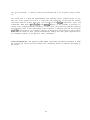
introducing different kinds of locks, for example read- and write-locks. The compatibility relation
between i.hctsc locks is usually specified by graphs such a s
where a solid arc states that two different processes may hold the respective locks on the variable
simultaneously, and a dotted arc means that a process may convert its lock from one kind to
the other. Such behaviors are easily described by abstract data types. But there are additional
problems that are more intrinsic and quite lengthy; therefore we have moved this discussion to the
appendix and treat the subject here in a more traditional way.
The goal of our development is best described by an example indicating the initial and the final
state of our intended development. (The names ,Y may be omitted in these protocols since they
are implicitly given by the respective processes.)
Example 1: We are given processes that issue operations of the type D I C T I O N A R Y .
II
...
I p p ::
...
w-lock(s); s := insert(s, x); w-unlock(s) . . .
1
. . . 1]
In the final program--this shall become (where according to the pointer implementation of section
3.6 the index c denotes the current subtrec of the process under consideration and an array notation
is used)
n-
...
II p p
1:
..*
r-lock (s[c]);
until s[c] is leaf
do c’ : = c; c := down (s[c]); r-unlock (s[c’]); r-lock (s[c]) od;
w-lock (s[c]); s[c] := add (s[c], x); w-unlock (s[c])
...
II
...
II
(End of example)
.
The purpose of the transformation to bc found is therefore twofold: When the recursive function i n s e r t is irnplcrncntcd by a loop, the locking shall not continue throughout the iteration.
Furthcrrnorc, not the whole object but only the currently accessed part is to be locked. In the
sequel WC will deal with both problems in turn.
Recall the equivalence relation of section 3.1, where two trees arc equivalent if they have the same
set of leaves. Under this equivalence relation the operations reset, up and d o w n are the identity
a-nd therefore can be taken out of the critical region. We delay the details to the appendix and
assume for the time being that certain operations _ marked here by underlining - allow the
following (informal) transformations
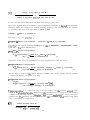
( T 1)
lock(t); t := down (t)
II
-v
r-lock(t); t := down(t); r-unlock(t); lock(t)
This means that a down-operation that immediately follows a locking allows an interruption of the
locking af-tcr its execution. The analogous rule holds for an unlocking alter the down-operation.
Hut note that such an interruption is not permitted in the middle of a critical region. In addition
W C need technical rules such as distributivity over c o n d i t i o n a l s t h a t have to bc cxt,(\nd(d f r o m
classical programming constructs to locks:
17
l o c k ( t ) ; if p ( t ) t h e n A e l s e B f i
P-2)
r - l o c k ( t ) ; if p(t) t h e n loTk(t); A
else lock (t); B fi
In both transformations lock stands for either read-locks or write-locks.
These rules together with the meanwhile classical fold/unfold techniques of Burstall and Darlington
suffice to restrict the locking to the actually necessary periods of time: We start from the sequence
of operations that stems from implementing insert by A d d
w-lock(t); t := Add (t, x); w-unlock (t)
and make it into a the procedure
proc Add* = (mtree t, elem x)mtree :
w-lock (t); t := Add (t, x); w-unlock(t)
IJnfolding of the recursive definition of Add given in the type EXTENDED
yields after a few minor simplifications
TRAVERSABLE
TREE
proc Add* = (mtree t, elem x)mtree :
w-lock (t);
if l(t is leaf) then t := down (t); t := Add (t, x); w-unlock(t)
else t := add (t, x); w-unlock(t)
fi
Application of the above transformations and some simplifications yield the version
proc Add* = (mtree t, elem x)mtree :
r-lock (t);
if l(t is leaf) then t := down(t); r-unlock(t); w-lock(t); t := Add(t, x); w-unlock(t)
fi
else w-lock(t); t := add (t, x); w-unlock (t)
Now we have an instance of the original definition of A d d * , which allows folding and thus produces
a version that directly corresponds to a loop:
proc Add* = (mtree t, elem x)mtree :
r-lock(t);
if ‘(t is leaf) then t := down(t); r-unlock(t); Add *(t, X)
else w-lock(t); t := add (t, x); w-unlock(t) fi
‘L’hc second problcrn t o b c a d t l r c s s c d h e r e i s t h a t o f l o c k i n g o n l y the a c t u a l l y acccsscd n o d e s
instead of the whole tree. After the application of the transformation of sections 3.5, 3.6 we have
a collection of individual objects in the place of the monolithic single tree. (We will U S C the array
notation here.) The following transformation describes the transition from the locking of the whole
array to the locking of single entries:
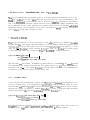
( T ‘4
lock(a); a[i] := e; unlock (a)
II
+
lock(a[i]); a[i] :== e; unlock(a[i])
18
If several elements are accessed in the critical region they have to be locked simultaneously. (As is
well known such a simultaneous locking can be implemented sequentially by establishing an order
relation between the single elements. In our case “father before son” would be an obvious choice.)
This simultaneous locking even can distinguish read- and write-locks. Of course, an application of
this transformation is only reasonable if the number of elements accessed in the critical region is
..
limited.
There remains one issue. The abstract data type M U L T I P L E T R E E requires that a substitution
must not take place if certain sub&es are the current trees of other processes. in a sequential
environment violation of such a requirement causes the program execution to abort. In a concurrent
environment we would rather see the process wait until some other process has resolved the
violation. (If no other process is kind enough to do this we have infinite waiting”.) The simple
solution is a re-interpretation of the undefinedness expressed in the restrictions of our data types.
We will adopt this solut,ion here for the sake of brevity although it has severe drawbacks from a
practical point of view: A process repeatedly locks and unlocks the variable in question just to see
whether the violation still exists. In this way, it continuously interferes with the other processes.
Furthermore, testing of the violation means that it has to know what the current subtrces of the
other processes are. Both problems are typical candidates for a solution by locks. Therefore we
might introduce two-new kinds of locks, one standing for “I am here” and the other standing for
“I am the only one here”. The former is compatible with both read- and write-locks, the latter
with no lock. Although this leads to the most practical solution we will not pursue the subject
here further.
3.9.
S UMMING
UP
THE
TR A N S F O R M A T I O N S
What have we gained by the lengthy considerations of this chapter?
s
Assume that the aforementioned tools and transformations indeed are at our disposal (maybe even
aided by a mechanical system). If W C now have to develop a program that applies some fairly
complex operations to a certain tree structure -- i.e. to a rccursivc data stucturc - then all we
have to do is specify the individual tree transformations (for example, how a new leaf may be added,
how rcstructerings can bc done etc.) Since this specification is not burdened by implementation
details, it very clearly reveals the underlying algorithmic ideas.
Once this step is done, the rest of the implementation can be done almost automatically by applying
our transformation rules. The result is a program that does the desired operations in a pointer
implementation and possibly even in a concurrent environment.
T h e rest of this paper will present an application, viz. the dcvclopment of concurrent operations
o n 2-s-trees. ‘According to the aforementioned principles it will suflicc to describe the various
individual operations as basic tree operations.
4Comparo the ongoing clisputc in the arca o f p r o g r a m m i n g l a n g u a g e s e m a n t i c s w h e t h e r i t i s a d m i s s i b l e t o identify
abortion and nontermination.
19
4. A N A P P L I C A T I O N : IMPLEMENTING
S ETS
BY
2-3-TREES
How do the aforementioned techniques apply in a concrete program development? First of all,
recall that it sufices to cast one’s ideas about the algorithm into basic tree transformations. The
rest of the development is done using the rules of the previous chapter. Therefore we will develop
here a sequence of more and more relined versions of trees together with suitable enrichments until
all our intentions arc met. These intentions are essentially those given in the literature on 2-3-trees
and B-trees and they will be explained in due course. This leads to a nicely structured development
process where we cope with one issue at a time.
4.1. BASIC ?&s-TREES
The average performance of the tree operations is best when the trees are “balanced’, i.e. when
all paths have the sarne length. Obviously addition as well as deletion violate this property unless
a restructering of the tree takes place. The costs of these restructerings can be kept low -- in the
order log N - if 2-3-trees (or more generally R-trees) are used. In a 2-3-tree every node (except
for the leaves) has either two or three sons. The type 2-3-TREE is therefore defined by
type tree = leaf (elem item ) 1
cons 2(tree sonl, tree son2) 1
cons S(tree sonl, tree son2, tree son3)
(We will often use the notation . is c o n s as an abbreviation for . is c o n s 2 V . is cons3.) In data
base applications one usually works with the more general D-trees (cf. [d]), where every node has
between m and 2 m - 1 sons. Clearly 2-3-trees are just the special case m = 2. For simplifying the
presentation W C will restrict ourselves to this special case.
4.2.
ORDE R ED T REES
A first decision that considerably increases the eIIicicncy of the int,ended implementation is to
use only “ordered trees”. The straightforward spccilication of this requirement would be to use
functions m i n and max that yield the smallest and largest leaf of the tree. But the values of these
functions may change on deletion or addition. Therefore it is better to work with upper and lower
bounds. This leads to the following rcdclinition of the basic 2-3-trees into
type tree = leaf(elem low, elem item, elem high) 1
cons 2(tree sonl, tree son2) 1
cons 3(tree son1 , tree son2, tree son3)
(Jsing these bounds the ordering rcquircrncnt is easily spccificd. (By +l we denote the successor of
an clement of the type elem, which is from now on assumed to be linearly ordered.)
20
type O R D E R E D
2-3-TREE declares Iwb,upb :
enrich
2-3-TREE b y
opns:
upb :
tree +
tree +
k/tree t :
elem
elem
Iwb :
axioms:
Iwb(t) = low(t)
= Iwb (son1 (t))
upb(t) = high(t)
= upb (son2 (t))
= upb (son3 (t))
if
if
if
if
if
t
t
t
t
t
is l e a f
is c o n s
is l e a f
is c o n s 2
is c o n s 3
required: V tree t :
upb(sonl(t)) + 1 = lwb(son2(t))
upb(son2(t)) + 1 = Iwb(son3(t))
if t is c o n s 3
end of type
-Note that this is a specification and does not prescribe any particular implementation. The optimal
solution, where the information about the bounds is distributed all over the tree (cf. [I]), is still
included here.
The ordering also provides us with a predicate P as required in section 3.15: For an arbitrary value
y --- actually th-e one to be searched in the tree - the predicate Py(t) is Iwb(t) I y < upb(t). D u e
to the definitions of I w b and u p b this is true for exactly one of the sons if it is true for the father.
‘I’~IIS we introduce the type
type
-
declares P :
P TREE
enrich
ORDERED
opns:
P:
axioms:
V tree t, elem y :
2-3-TREE by
t r e e -+
Py(t) = true
= false
boo1
i f Iwb(t) 5 y 5 upb(t)
otherwise
required: Vtree t :
P(son1 (t)) V P(son2 (t))
P(son1 (t)) A P(son2 (t))
if
if
= true
= false
t is cons A P(t) = true
t is cons A P(t) = true
end of type
The requirements arc fulfilled by definition.
GAs a matter of fact, tliis rcquiremcnt m o t i v a t e s t h e i n t r o d u c t i o n o f a n o r d e r i n g .
21
4.2. A DDITION
D ELETION
AND
OF
LEAVES
The basic operations needed for implementing sets in terms of trees are addition and deletion of
leaves. This can be done according to the following figures.
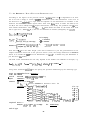
Example 2: Consider the addition of the value 2 to the trees given below; this leads to the
following tree transformations
/\
1
3
Case 1: addition of the value 2
r
I/i\
3
,/’ /’‘I\
/a\ ““\
1
4
2
3
4
Case 2: addition of the value 2
(End of
example)
E x a m p l e 3: Assume that we want to delete the value 2 from the tree given below.
1
A\
2
r
/\
3
1
3
Case 3: removal of the value 2
The problem with this solution is that the node r disappears when it has only two sons one of
which is to be deleted. This is unpleasant when it comes to concurrency, since such problems
are candidates for deadlock situations. To shorten the presentation we adopt another solution
and introduce the notion of an empty tree (a leaf without an item). This means that we add the
variant empty (elem low, elem high) to the recursive type declaration above and extend the type
ORDERED 2-&TREE accordingly. fjy s is terminal WC abbreviate (s is leaf v s is empty). Thus we
gel the transformation (whcrc no nodes need to bc eliminated for lhc time being):
r
r
1
I\
2
1
Case 4: deletion o f t h e value 2
(End of cxarriplc)
22
/\
0
The specification of these operations according to the above figures is easy. To shorten the writingdown we neglect the optimal solutions of cases 1 and 3 and treat all situations according Lo cases
2 and 4.
type
TREE1
enrich
declares add ,delete :
by
PTREE
tree X elem --+
tree X elem +
Velemx,y,I,h :
add :
delete :
axioms:
add (leaf (I, x, h), y)
tree
tree
= cons 2(Ieaf (I, x, x), leaf (x + 1, Y, h))
= leaf (I, x, h)
= cons2(Ieaf(I,y,y), leaf(y + 1,x, h))
add(empty(I, h),y)
= leaf(l,y, h)
delete(leaf (I, x, h), y) = leaf(l, X, h)
= empty (I, h)
i f x<y
if x=y
i f x>y
if x#y
if x=y
delete(empty(I, h),y) = empty(l, h)
required: V tree s, elem y :
for
for
s is terminal A Iwb(s) 5 y 5 upb(s)
s is terminal A Iwb(s) L y L upb(s)
add (s, y)
delete (s, y)
end of type
T h e t r a n s f o r m a t i o n s o f s e c t i o n 3 . 2 n o w p r o d u c e a t y p e E X T E N D E D T R E E or a type E X T E N D E D
T R A V E R S A B L E T R E E, which are both implementations of the type D I C T I O N A R Y . Note that as a
byproduct of the ordering the subtree where the addition and deletion take place is uniquely determined, Lhus making the potential nondeterminism in the transformation of section 3.2 harmless.
Also, the extension to multiple trees is easy since no substitution erases a subtree.
5. R E P A I R I N G
-
D EGENERATE T R E E S
The operators defined above produce trees that may be degenerate in either of two ways: There
may be empty subtrees as the result of a deletion; these subtrecs should bc erased. And there may
be search paLhs through the tree that are considerably longer than other paths; but for a better
overall performance of the tree operations all paths should have the sarne length. The purpose of
working with 2-3-trees instead of ordinary binary trees is to allow the re-balancing of degenerate
trees without too much overhead.
The principal idea of the repairing can -- by abusing a tcrrninology of artificial intelligence - be
skclchcd as follows: The operaLions add and dclctc search Lhc leaf in yucslion and then a p p l y t h e
necessary changes. T h e s e changes may cause a disturbance of the balancing. Whenever such a
degeneration exists “a demon is triggered” that tries to repair the tree. The actions of this demon
may lead to further disturbances which are treated in turn until the tree is in perfect shape again.
This principle leaves a number of choices: The “demon” may be one or more processes that are part
of the data strucuturc itself such that the requesting processes are not even aware of something
going on in the data base after they have finished their task. Ijut one also may charge the process
responsible for Lhc degeneration with the task of Lhc demon by forcing it lo do all necessary repairs
i)Jflre l e a v i n g the d;tl;t base. In boLh casts there is a further decision possible, viz. the d e c i s i o n
23
whether the treatment of one degeneration may produce at most one or several new disturbances.
These issues will bc treat& in detail later on.
5 . 1 . BA L A N C E D T R E E S
To express the balancing requirement W C need an operation that determines the “height” of a tree,
i.e. its distance from the leaves. However, in the case of unbalanced trees such an operation is not
well-defined. To overcome this deficiency we associate to each (sub)tree a “disturbance” that is
>+I if the tree is too high in comparison with its environment and I-1 if it is too short; otherwise
the disturbance is 0. Then we can replace our previous notion of height by a “virtual height”,
which is corrected by the disturbances. This calls for another modification of the original type
2-3-TREE:
type tree = empty (int dist, elem low, elem high) 1
leaf (int dist, elem low, elem item, elem high) 1
cons 2(int dist, tree son1 , tree son2) 1
cons S(int dkt, tree sonl, tree son2, tree son3)
The balancing requirement now can be forrnulated by the type
type
BALANCED
2-3-TREE declares height :
enrich
2-3-TREE b y
opns:
h e i g h t : t r e e -+
axioms:
Vtree t :
int
height(t) = -dist (t)
= height(sonl(t)) + 1 - dist(t)
if t is t e r m i n a l
if t is c o n s
required: V tree t :
-
if t is c o n s
if t is c o n s 3
height(son1 (t)) = height(son2(t))
height (son2 (t)) = height (son3 (t))
end of type
The h-eight gives for any path p from the root to a leaf the value “number of edges on p”--“sum of
all disturbances along p ” . For easier rcadibility we will from now on use the notation c o n s 2&(r, s)
instead of cons 2(6, r, s) ( analogously for leaf and cons3).
The change in the definition of 2-3-trees requires an according modification of the operations a d d
and delete :
type
2-3-TREE1 declares a d d ,delete :
enrich
PTREE
opns:
add :
delete :
@ BALANCED2-i&TREE
tree X elem 4
tree X elem 3
b y
tree
tree
24
axioms:
V elem x, y, I, h, int a! :
add(leaf*(l,x, h),y)
= cons2°+1(leafo(l,x,x),leaf0(x + l,y, h))
= leaf a(l, x, h)
= cons 2a+1 (leaf ‘(I, y, y), leaf ‘(y + 1, x, h))
add(empty”(I, h),y)
= leafa(l,y, h)
delete(leafQ(I,x, h),y) = leafa(l,x, h )
= emptyU(I, h)
delete(emptya(l, h),y) = emptya(l, h)
i f x<y
i f x=y
i f x>y
if xfy
if x=y
required: V tree s, elem y :
s is terminal A Iwb(s) I y I upb(s)
s is terminal A Iwb(s) 5 y I upb(s)
for
for
add (s, y)
delete (s, y)
end of type
13~ the same construction as before this becomes an implementation of DICTIONARY. Note that
height(add (s, y)) = height(s) and height (delete(s, y)) = height(s).
5.2. L OCAL
REBALANCING
The following figures shall give a first intuitive idea of the operations that arc used to repair
degenerate trees. The notation r(,,) indicates the disturbance of r.
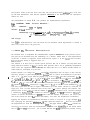
Example 4: Empty subtrees have to be eliminated. The only problematic case arises when there is
only one brother. The resulting shortening of the tree has to be compensated by the disturbances.
(Note that a may be empty as well.)
a b+-1)
r (4
/\
a (4 0
C a s e I: Eliminating empty subtrees
-
( End of example)
For the rest of this section we will be concerned with repairing disturbed balances. For simplicity
W C assume in the illustrations below that the node b (or both a and b) has a disturbance +1 while
the other ones have disturbances 0.
Example 5: Assume that the node b in the following trees is unbalanced, i.e. has a true height
that is (by 1) greater than that of its brothers.
C a s e 2: rebalancing in case of two sons and one brother
25
Case 3: rebalancing in case of three sons and one brother
Case 4: rebalancing in case of two brothers
r (+I)
/\b
d
/i\
e
f
g
/I\
h
c
Case 5: rebalancing in case of two high subtrees
r (+I)
/b-lb,
/I’
a (+I)
d
/I\
e
f
d
C
A\
e
I\
f
i
C
Case 6: rebalancing in case of two high subtrecs
Note: Case 5 esscntiallly also applies if b has only two sons (a having tither two or three sons). Of
course, there also are various syrnetrical situations where the roles of brothers are exchanged.
How do more complex situations of disturbances influence thcsc pictures? Let us consider one
rcprescntative example in full detail, using the algebraic tools provided by the data type technique.
The intuitive idea rcflcctcd in figure 4 leads to the general equation (with the indcterminates
cy ’ 7 *** 9 0’):
r&d = cons3P( aa , cons 3p(c7, d6, e’) , f$ )
r new = cons 2P’( cons3@(aa’, c7’, d6’) , cons 2O’(e”‘, fc’) )
To determine the new disturbances we use the following design criteria:
l
It must bc possible to substitute the new tree for the old one in any given environment. Therefore
we have to rcquirc height(r,,,) = height(r,ld).
26
l
The node w h i c h is the focus of attention -- in our case b - has to be completely repaired. This
means /Y = 0.
l
The transition should affect as few nodes as possible. This means in particular that we do not
want to alter the disturbances of c, d and e. Therefore we require 7’ = 7, 6’ = 6, E’ = E (provided
that this does not lead to an inconsistency). _
The calculations center around the axioms and restrictions of the type BALANCED 2-3-TREE. The
disturbance a’ of the node b’ is determined by the decision p’ = 0 and by the two restrictions
height(consB@(. . .)) = height( c o n s 2”‘(. . .)) A height (e”) = height(e’) = height(d6) = height(d”)
t--- height(d6’) + 1 - p’ = height(e”) + 1 - O’
k a’=&?‘=o.
Analogously, the equations height(d6) = height(d6’) and p’ = 0 allow us to determine p’:
height(r,ld) = height(r,,,)
t-- height(d6)+l-~+1-p=height(d6’)+1-~’+1-p’=height(d6’)+2-p’
I-
P’=PO
It remains to consider (II’ and <. Using the last result p’ = p + ,0 this becomes:
height(r,l,j) = height(r,,,)
t--- height(aO) + I - p = height(aa’) + 1 - /I?’ + 1 - p’ = height(aa’) + 2 - p - /3
t- a’=a-D+l
and analogously
<=<-p+1.
When doing the same computations for the other cases it turns out that the last equation (a’ =
cy - ,f3 -t 1) always holds for the “lower” brothers. The father r always gets a new disturbance of the
kind p’ = p + p, except for case 2 where it is p’ = p + ,O - 1. (A s a rule of thumb use the fact that
for every path in the pictures the value “sum of all disturbances minus number of edges” must be
the same in both trees.)
Before we cast the above results into an abstract data type
l
-
WC
should address a few issues here.
A s s u m e that we start from an initial tree of the form leaf’(. . .). This tree has height 0. Since
all our operations arc designed such that they leave the height invariant and since this height is
(for any path p from the root to a leaf) equal to
“nurnber of edges of p”-“sum of disturbances along p ”
it is irnpossiblc to set all disturbances to 0 Therefore a “truly balanced” tree contains at most
o n e nonzero disturbance, viz. the one at tho root, and this disturbance states the length of all
paths. (The identifier “height” has thus lost its mnemonic meaning for the root.)
Y Working with both positive and negative disturbances minimizes the number of nodes to be
changed. But we could equally well U S C o n l y positive disturbances: Consider a node r with
disturbance -6 < 0. If we subtract 6 from the father and add S to all brythcrs the d i s t u r b a n c e
of r becomes 0. This doesn’t c h a n g e anything in the cases 2 - 6.
l
l
The sum of all disturbances of the tree decreases in cases 2 - 6 with two exceptions, namely
cases 3 and 4 when ,0 = 1. In this case the sum remains invariant but the disturbance moves
closer to the root. Therefore the rebalancing will eventually terminate (provided that no further
additions or deletions take place).
Each of the repair operations keeps the set of leaves of the tree invariant and therefore is t h e
identity in our underlying equivalence relation.
27
5.3. A N A B S T R A C T
D A T A T YPE
FOR
REBALANCING
According to the figures of the previous section a subtree with root r is degenerated if at least
one of its sons is empty or carries a nonzero disturbance. (Note that disturbances of the root of
the whole tree are neglected.) To cope with the explosion of case distinctions we introduce a few
notations and definitions. In the figures above there were three levels of nodes: the father r, t h e
son b (or the sons a and b) with the highest disturbance, and finally the grandsons and the sons
with smaller disturbances. The tuple (tr, . . . , tn) shall denote the nodes on the lowest level from
left to right. For r = c o n s 3(a, b, c) this can be formalized as follows (analogously for cons2):
(b.., tn) = (7(a), w, W))
where for any son sQ of r
0
sLnazdist+l
7(e) =
I (son1 (s), son; (s), son3 (s)),
maxdist =
if s is empty;
if CT < maxdist;
if Q = maxdist.
max(dist(a), dist(b), dist(c)) + 1 ,
max(dist (a), dist (b), dist (c)),
if dist(a) = dist(b) = dist(c)
otherwise
Note that all t; have the same height. (The above formulae arc just the generalization of the
sample calculation carried out in the previous section.) Also, the strange definition of m a x d i s t
allows us to include the case where all disturbances arc equal in a uniform way (the disturbance is
just moved to the father).
The form of the transformed tree now only depends on the number n of elements in the tuple, e.g.
t
=
(tl,t2,t3)
*
mew =
cons 3P’(tl, t2, tg)
where p’ = p + maxdist - 1
Using these shorthand noht,ions we can specify the operation rebalancing by the following type:
type
2-3-TREE2 declares r e b a l a n c e :
a enrich
opns:
axioms:
PTREE
rebalance :
@ BALANCED2-3-TREE
t r e e -+
b y
tree
V tree a, b, c, int CY, /?, 7 :
let
(tl, . . . , tn) and m = maxdist be defined as above
in
rebalance(P) = emptyp-‘(Iwb(r), upb(r))
=
m-2
h
= cons 2p+m-1(tl, t2)
= cons3p+m-1(t~, t2, t3)
= cons 2p+m(cons 2’(tl, tz), cons 2’(t3, td))
= cons 2p+m (cons3’(tl, t2, t3), cons2’(td, t5))
= cons 2P+m(cons 3’(tl, ta, t3), cons 3’(t4, t5, tG))
= cons3P+m(cons 3’(tl, t2, I+), cons 2’(t4, ts), cons 2O(tc, t,))
required: V tree t :
for
dist(son i(t)) z 0 V son ;(t) is empty
end of type
28
rebalance(t)
if n = O
if n = l
i f n=2
i f n=3
i f n=4
i f n=5
i f n=6
if
n = 7
The peculiar forms of the first three cases take into account that empty subtrees may occur side
by side with disturbances. Note that the operation r e b a l a n c e is the identity under our equivalence
relation for trees.
The transformation of section 3.2
type
EXTENDED
TREE2
now produces the nondeterministic specification
declares Rebalance :
opns:
Rebalance :
axioms:
Vtree t, 3 tree s :
--b
Rebalance(t) = t[s e rebalance(s)] A s f t A (dist(son;(s)) # 0 V soni is empty)
if 3 tree s : s 3 t A (dist (soni( # 0 V son ;(s) is e m p t y )
= t
otherwise
end of type
This type is nondeterministic: The restrictions do not determine which degeneration is treated if
there exist several ones in the given tree.
5.4. D EMONS
We somehow
The goal can
in the tree a
degeneration
VS.
IN D I V I D U A L
RESPONSIBILITY
have to implement the nondeterministic operation Rebalance of the previous section.
be described using the terminology of a “demon”. When there is some degeneration
“demon is triggered” which miraculously repairs it. If this repair causes another
the demon is triggered anew, etc.
One solution is to have (one or several) special processes that act as demons. To keep them from
doing exhaustive searches we have to provide these processes with a list of (potentially) degenerated
nodes. Since the operations a d d and d e l e t e also affect this list it is a shared variable (which we
could model by associating it to the tree).
-
Another solution is to charge the process causing the degeneration with its repair. In this case the
following property is particularly pleasant: Assume that we restrict all disturbances to the three
values -1, 0 , +I. Then we get from the property (e.g. in case 4) ,0>, the three possibilities (a,/?) =
(0, +l), (CY, p) = (-l,O), (cx,~) = (-1, +l). In the first and second case we get the new disturbances
a’ = t = 0, in the third one CX’ = { = - 1 = < = cy. T h e d i s t u r b a n c e o f r becomes either p’ = p ( i n
case 2) or p’ = p+ 1. The latter case enforces the additional restriction p < 0 for the applicability of
the operation r --*
e b a l a n c e Analogously, in the cases n= 0,1,2 we have to avoid disturbances c--l.
This may require that we shift a negative disturbance up to the father r before W C eliminate an
empty tree. Also, to avoid deadlocks some of the cases 2 - 6 need a splitting into subcases. The
pleasant effect of this setting is that the number of nonzero disturbances never increases through
a rebalancing. lG~rthermore, an addition or deletion effects at most one d i s t u r b a n c e . Ilcnce, t h e
number of nonzcro disturbances is ncvcr greater than the number of processes. (Of course, the
root of the overall tree has to be treated individually, since here the disturbances accumulate.)
Applying the sequence of transformations described in section 3 we arrive at a type “multiple 2-3tree” specifying the operations rebalanceP(t) which repair the current tree p. Since we can localize
the degenerated tree from our knowledge of its lower and upper bound we could cvcn generate the
necessary tree traversal with our transformations. 13ut this is not reasonable, for the search would
start at the root every t i m e a n e w . Yet, W C know that the only new degeneration possibly arising
29
frorn the repair is localized at the father. In appendix A we briefly discuss suitable variants of the
transformations for introducing tree traversal. In our application we get
axiom
V ttree t :
F(t)= F(up (subst (;, rebalance(current
= t
(t))))
if R(son ;(current(t)))
otherwise
where R(s) = dist(s) z 0 V s is e m p t y
Finally, to show deadlock-freedom we have to consider the possible violations of those restrictions
that refer to other processes. Such restrictions only occur in the operation s u b s t of the type
MULTIPLE TREE+. Therefore we have to examine all cases of the operation r e b a l a n c e w i t h
respect to these requirements of s u b s t . The only critical nodes are the “higher” sons of r (see
the figures 2 - 6), they must not be the current trees of other processes. For downward processes
- A d d a n d D e l e t e - there is no problem: they are not restricted in any way and thus will
eventually move on. An upward process - repair - does not conflict with r either and therefore
will eventually move up to r (where an arbitrary number of processes are permitted). In other
words, the type EXTENDED MULTIPLE TREE has the invariant property that that there is at
least one p for which no requirement is violated.
6. C O N C L U S I O N
This paper exemplifies the typical approach that is taken for the derivation of new transformation
I&S. One considers the solution of a special problem and analyzes it carefully. The goal of this
analysis is to extract the essential aspects of the solution, filtering out all unimportant details.
T h e second step is to put this extracted knowledge into a generalized schematic form that is
mechanically applicable. The final step has been ornitted here, viz. the design of a convenient and
precise formalism into which the technical details can be cast.
Such a schematic and formalized development has an important side-effect: Though sornetimes
looking quite intrinsic and complex the various applicability conditions of the transformations as
well as certain enrichments of types indicate what is actually needed to perform a safe development.
These proofs are ncccssary to guaraniee correctness -- in whatever technique or notation they are
carried out. Even if there remains a lot of work to bc done on the user’s side, the transformations
tell hirn at least which problems he has to attack.
The future research on this subject has to address two points (and probably in that order): First,
it is necessary to study other special type transformations. For example, how do the rules in this
paper- work for systems of mutually recursive type declarations ? What are the possibilities if we
allow infinite objects in the style of Dana Scott? Consider the system of equations
u = cons(v, w),
v = cons(w, u),
w = cons(u, v).
The fixpoint of these equations describes the doubly linked list
The transformations for pointer implementations apply hcrc in a straightforward manner. Finally,
how do other types that are not recursive declarations fit into the approach? Note for instance that
30
the type
etc.
DICTIONARY
i s “almost” recursively describable and so are sequences, queues, stacks,
The second issue is to back the transformations more rigorously from a semantical point of view.
The most severe problem arises here in connection with parallelism. In particular the possible
connections between abstract data types and concurrency need further exploration. Types such
as M UL TI PL E TREE allow a spccilication of the overall behavior of the ensemble of processes according to the multiprogramming assumption. In this respect the universally quantified equations
and restrictions show a close relationship to the Cl-operator of temporal logic and the existential
quantilicrs correspond to the eventuality operator 0. When these connections are better understood, one can search for more general transformations leading from such global specifications to
the individual protocols of the processes under consideration.
Acknowledgement I am grateful to Zohar Manna for providing the pleasant environment in which
this research was carried out. Pierre Wolper was a stimulating partner in numerous discussions on
the subject.
31
APPENDIX
This appendix addresses a few points that were too lengthy for being included into the main part
of the paper. Again the discussion will not be overly formal.
A PPENDIX
A:
N ONDETERMINISM
IN
A BSTRACT
DATATYPES
Nondeterminism as it is used in some of today’s more advanced programming languages is characterized by its completely “erratic” nature. This means in the first place that one cannot predict
the result of a computation. But in addition it may even happen that two executions of the same
expression under the same circumstances yield different results. Within the classical framework of
abstract data types we can only mirror the former aspect, the latter requires an extension to rclational theories. (Though being aware of this gap we will still speak of nondeterminisrn here. After
all, we only want to apply abstract data types and do not model the semantics of programming
languages.) This limitation even has its advantages: In our restricted nondeterminism we are still
allowed to use an equation such as x = e to substitute x by th’e expression e without problems.
The general case of
operation f together
subtree s of a given
unless there actually
Vtree t :
the transformation in section 3.2 is characterized as follows: We are given an
with a restriction R of its domain and we want to substitute some admissible
tree t by f(s). Let us call this substitution F(t). Since we must not apply F
exists a subtree s with R(s), the axiom reads
3 tree s : s +A R(s) ) - ( 3t ree s : s 3 t A R(s) A F(t) = t[s + f(s)])
According to our use of restrictions we can split this up into an axiom and a restriction:
Vtreet:3trees:s_ftAR(s)AF(t)=t[s+f(s)]
axiom
required Vtree t : 3 tree s : s f t A R(s)
for F(t)
In the a d d -example of section 3.2 the requirement is R(s) = s is leaf. Since there always exists a
subtrec s of’ t fulfilling this rcquircmct the restriction can bc ornittcd.
4s a second example consider the definition
delete (leaf(y), y) = empty
with the restriction
s = leaf(y)
for delete (s, y)
IIere the restriction determines the application point uniquely and therefore we get the simplified
version
axiofn
v tree t, elem y : Delete(t, y) = t[leaf(y) + empty]
required Vtree t, elem y : leaf(y) 3 t
for Delete(t, y)
Remark: This example shows that it will be useful to have the transformation in two flavors. In one
-_ which we have used here - the new operation F is undefined if there does not exist a suitable
subtree, in the other form F is made into the identity in that case.
There is a second major instance of nondeterinisrn: Certain operations that are applicable at several
points in the structure shall be executed “as often as possible” but in arbitrary order (the “demon”
of section 5). The order of applications m a y decisively influence the result, in particular when the
operations may gcncratc new application points. In this case W C modify the previous rule such
that f is applied repeatedly. The axiom then reads
32
axiom
V tree t : 3 tree s :
s f t A R(s) A F(t) = F(t[s % f(s)]
F(t) = t
if 3 tree s : s f t A R(s)
otherwise
Note that F now is, of course, the identity when there is no application point.
The rebalancing example in section 5 shows the need for a generalized variant of this rule. There
a process should not treat all degenerations but only those that were reachable for it, i.c. those on
the path from the current node back to the root. This leads to a modification of the transformation
rule: Assume that the restriction R of the operation f is of the form
required V t :
R(son i(t))
f o r f(t)
Assume further that f may establish the truth of R on its result, i.e. R(soni(t)) may cause R ( f ( t ) ) .
Then W C simply have to move upwards. In this case F is defined by
axiom V ttree t :
F ( t ) = F ( u p ( s u b s t ( t , f ( c u r r e n t ( t ) ) ) ) if R ( s o n ; ( c u r r e n t ( t ) ) )
= t
otherwise
A PPENDIX
B:
M ORE ONPOINTER
IM P L E M E N T A T I O N S
This part of the appendix describes the technical derivation of the pointer implcmcntation of
section 3.5 in greater detail and also gives a brief accent on the underlying model that justilies
the transformation. The transformation probably is intuitively clear to anyone who has cvcr done
programming with pointer structures. But if we want to do better than referring to the reader’s
intuition W C have to go into some elementary mathematics.
A finite [napping can be represented by a Gnite set of pairs. If we use pairs of the form (i, x) with
i E index a n d x E c o n t e n t s W C have a (terminal) model of the type S T O R E. Trees are special
graphs, which in turn can be represented by mappings. In this setting the operation cons (a, b) i s
implemented by
A kJ BkJ {(n&A,m))}
-
where the mappings A and B represent the trees a and b, U is the “disjoint union” of mappings (all
indices of B are consistently rcnamcd), rA, r-B arc the roots of A and B and nl is a “new” index.
Consequently, the function substitute(A) 8, C) yields a new [napping A’ that is derived frorn A b y
replacing the submapping B by C (obeying the possibly required renaming of indices).
An cffrciency measure suggests itself. Assume that A’ is as similar to A as possible (i.e. the indices
arc accordingly renarned). Then the differences D = A - (An A’) and D’ = A’ - (A n A’) tell us h o w
many pairs in A arc altered or added to achieve A ’ . In the following constructions the sizes of D
and D’ depend directly on the length of the given expressions (and not or1 the sizes of A, B and C ) .
Therefore the cost is constant. Consider the example of section 3.5:
A’ = su bstitute(A, S, U)
where S= cons(cons(A, B), C)
= Au Bu c u {(nl,(rA, b3))) u {(b (nl, w))}
U= cons(cons(A, L), cons(B, C))
= Afd Lu Bkt cu {(k2,(rA,rL)>} M {(n&Id-C))> kd ((b(~l~k2)))
L= {(n:hleaf(x>)}
33
The only elements not in A f-l A’ are
{(nl, (TA, rI3))h hh (“1, @)))
{(n3,leaf(x)>), {(n2, (TA, u))), {(nt, (m, m)D, {(no, h r2))l
Consequently, it suffices to exchange the right-hand sides of no and nl and to add the pairs for n2
a n d ng.
How is this mechanized in a purely syntactic fashion ? The following algorithm derives the necessary
information by inspecting the given expression. Since the tree s to be substituted frequently is not
given in the cons(. . ,) form WC reformulate the above expression:
t’ = substitute(t) s , cons( cons(son1 (son1 (s)), leaf(x)) , cons(son2 (son1 (s)), son2(s)) )
Dy using auxiliary identifiers this r e a d s
io = s
il
i2
i3
id
=
=
=
=
j0 = cons(h,j3)
son1 (io) = son1 (s)
son2(io) = son2 (s)
son1 (il) = son1 (son1 (5))
son2(il) = son2(sonl(s))
jl = cons(ig, j2)
j2 = leaf(x)
j3 = cons(i4, i2)
The above dctailization follows the rules: Every subtcrrn of the kind soni(. . .) gets its own identifier
(corresponding to its index in the original mapping). Every cons(. . .) and Ieaf(. . .) gets an index,
too. All idcntificrs ik of the left-hand side that do not occur on the right-hand side --- in our case
io and il - can be replaced by the corresponding j,. All j, not covcrcd in this way stand for new
indices -- in our cast j2 and j3. Translating this into a sequcncc of alter-cxprcssions of the type
- S T O R E lcads to the prograrn of section 3.5. The mechanical nature of this derivation is obvious.
The applicability condition is that the expression for the new tree u can be expressed in terms of
the old tree s and leaf-operations.
There are optirnizations possible. For example, if son2 (son1 (s)) would not occur in the expression
for-the new tree but several leaves arc added then the above algorithm assigns new indices (i.e.
storage locations) to many of the leaves without noticing that all indicts belonging to the subtrce
son2 (son1 (s)) arc available. To minimize garbxgc collection more ola.boratc variants arc therefore
needed.
Note that all operations in the paper -- addition, dclction, rebalancing -- meet the above rcquircments.
34
A P P E N D I X C:
A B S T R A C T D ATA T YPES
AND
LOCKING
In section 3 we have adopted a purely formalistic view of transformations for locks. Now we will
b c m o r e precise and also study to what degree abstract data types can be used and where the
problems arise.
To begin with, the multiprogramming-assumption explains parallelism in terms of sequential interleaving: If there are two processes P1 and P2 issuing sequences of “atomic” operations o = 01. ‘ok,
7 = 71’ “7, then the semantics of their concurrent operation is explained by the set of all possible
mergings of the sequences o and r. This set is called shuffle in [12].
l
Remark: Actually, the two processes generally influence each other. Therefore one has to model
their individual behaviors by some kind of formal trees and the shuffle has to be generalized such
that it merges trees into sequences.
Now assume that we started from n program where the operations CT and r were taken to be atomic.
The shuffle of this program therefore is the set
If o and 7 are then broken up into sequences of more elementary operations we must guarantee
that the shufIle of the new program is equivalent to the set
{al- “~k~l”‘~m, rl”‘?-,~l” ‘“k}.
On the other hand, the size of the shufIle indicates the degree of concurrency. One safe way of
increasing that size is enabled if the operation ~1 is exchnngcablc with CT, i.e. 07-1 = 71~. Then we
get the equivalent shufIle
a
A n a l o g o u s l y f o r r,, 01, ok and then for 72, e t c . In other words, we have to identify within the
sequence o the largest subsequence that does not allow the above interchanging. This leads to
w-here the sequence in parantheses is a critical region that has to be viewed as being atomic.
The above interchanging is in particular enabled for those operations a; that are the identity in
the given semantic interpretation. In the soquol we will treat this in the context of abstract data
types. (For shortening the writing-down we will restrict ourselves to one kind of locks.)
type L O C K (type M )
enrich
opns:
M bY
lock :
unlock :
locked :
declares lock ,unlock :
name
X m 3 m
n a m e Xm -+
name Xm --+
m
boo1
35
axioms:
Vmx, namep,n:
lockedp(lock p(x))
locked p(lock T(x))
locked .(unlock p(x))
locked .(unlock K(x))
locked .(f(x))
locked p(c)
fW f&4
f(unlock p(x))
= true
= locked p(x)
= false
= locked p(x)
= lot ked p(x)
= false
= f(x)
= f(x)
i f p#7r
i f
for
for
for
for
p#7r
all operations
all constants c
all operations
all operations
f of M
of M
f of M
f of M
required: Vm x, name p, 71:
llocked p(x)
for l o c k m(x)
if
7-P
end of type
This type specifies the essentials of locks. But it has its problems: A minor one is that the last four
axioms are generic. They just express the facts that the basic operations of the type M do not alter
locks and that, vice versa, locks act like the identity on all operations. This is exactly what we
need for the sequences occurring in the shuffle. But the severe problem is that these last equations
also can be used to eliminate any lock from any program --- before the shuIIle is built. Thus we are
confronted with the situ-ation that we need equations to specify the meaning of certain operations
but that we never must apply these equations to a program. In other words, types not only need
hidden functions but also hidden axioms.
If we accept the above extension of the type mechanism we have a valuable tool that makes the
“underlining” of section 3.8 more accurate. For particularly chosen functions such as up and d o w n
we may add the equations
= lock (unlock (down (lock(t))))
down (lock (t))
unlock (down (t))= unlock (down (lock (unlock(t))))
Now we can do the same development that we have done for the procedure Add* in section 3 . 8 ,
but in the applicative style of abstract data types. The operation A d d ’ with the initial definition
Add’(t, x) = unlock (Add (lock (t), x))
then gets the derived specification
Add’(t, x)= Add’(unlock (down (lock (t))), x)
= unlock (add (lock (t), x))
if lock (t) is cons
otherwise
The advantage of this more formal treatment is that we can state more precisely where read- a nd
write-locks will occur, for example
down (w-lock (t))
= w-lock (r-unlock (down (r-lock(t))))
rebalance(w-jock (t))= w-lock ( w-unlock (rebalance(w-lock (t))))
The intrinsic problem remains, of course, to determine which operations allow the addition of such
equations. For the operations such as up and d o w n this is done as a byproduct of the earlier
transforrnation rules. For other operations such as rebalance the user has to provide a proof e.g.
that the operation is the identity in a suitably chosen equivalence relation. In addition, it must
bc clarified whether a read- or a wri &lock is needed. The remaining details then are of a purely
mechanic nature such that we could leave them to a transformation rule I N T R O D U C E - L O C K S.
36
REFERENCES
[l]
A. V. AIIO , J. E.
HOPCROFT ,
J. D.
ULLMAN: The Design and Analysis of Computer Algorithms.
Reading, Mass.: Addison- Wesley, 1974.
[2]
[3]
F. L. BAUER, H. W~SNER: Algorithmic Language and Program Development. Berlin-Heidelberg-New York: Springer (to appear).
F. L.
BAUER
AL.: Report on the Wide Spectrum Language CIP-I,. Technische Universitzt
ET
Miinchen, Ins ti t u t fiir Informs tik _I 981.
[4]
R.
B A Y E R, M. SCHKOLNICK: Concurrency of Operations on B-Trees. Rcta fnforznatica 9,1-21
(1979).
[5]
]
M . BR O Y, B. MILLER, P. PE P P E R , M. WIRSING: A Model-Independent Approach to Implementations of Abstract Data Types. In: A. S A L W I C K I (ED.): Proc. Symp. on Algorithmic T,ogic and
the Programming Language LOGAN. Lecture Notes in Computer Science, Berlin-IIcidelbergNew York: Springer 1981
M. BROY,
P.
P E P P E R : Program Development as a Formal Activity. IEEE Transactions o n
Software Engineering, SE-7: 1, 14-22 (1980).
]
-
R. M. B URSTALL , J. A. G OGUEN : The Semantics of CLEAR, a Specification Language.
Proc. 1 9 7 9 C o p e n h a g e n W i n t e r S c h o o l o n A b s t r a c t S o f t w a r e Specihcation. Lecture N o t e s
in Computer Science 86, 1 9 8 0 .
[8]
J. A. GOCUEN, J. MESSEGUER: OBJ-1, A Study in Executable Algebraic Formal Specihcation.
SRI Jnternational, Menlo Park, July 1981.
[o]
C. A. R. IIOARE: Communicating Sequential Processes. Comm. l\CM 21:8, 666 677 (1978).
[lo]
K.
J E N S E N,
N.
WIRTH: PASCAL User Manual and Report.
New York-Heidelberg-Berlin:
Springer, 1974.
[II] Y. S. K W O N G, D. W O O D: Concurrent Operations in Large Ordered Indexes. In: 13. ROINNET
(cd.): Proc. 4th Tnt. Symposium on Programming, Paris, 1980. Lecture Notes in Computer
Science 83,202-222 (1980)
[l2]
[13]
S.
G I N S B U R G : The Mathematical Theory of Context-Free Languages. M C Graw Hill (1966).
M. WIRSING, P. PEPPER , II. PARTSCH, W. D OSCII , M. BILOY: On Ilicrarchies of Abstract Data
T y p e s . Technische Universitit Miincllen, lnstitut fiir Informalik 1’c/M-18007, 1 9 8 0 .
37