1
9640A
Instruction Manual
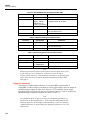
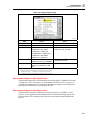
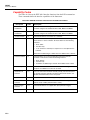
Standard Event Status Register
Bit 7 (weight 128) — Power-on (PON)
Shows that the Instrument’s power supply has been turned off and on (since the last time
the controller read or cleared this register).
Bit 6 (weight 64)—User Request (URQ)
Shows that the user has pressed a key on the front panel. This is not implemented on the
Instrument.
Bit 5 (weight 32) — Command Error (CME)
Shows that the instrument has detected a command error. This means that it has received
data that violates the syntax rules for program messages.
Bit 4 (weight 16) — Execution Error (EXE)
Shows that the Instrument detected an error while trying to execute a command. (See
Error reporting.) The command is syntactically correct, but the Instrument cannot
execute it, for example because a parameter is out of range.
Bit 3 (weight 8) — Device-dependent Error (DDE)
A device-dependent error is any device operation that did not execute properly because of
some internal condition, for instance error queue overflow. This bit shows that the error
was not a command, query or execution error.
Bit 2 (weight 4) — Query Error (QYE)
The output queue control detects query errors. For example the QYE bit shows the
unterminated, interrupted, and deadlock conditions. For more details, see Error
Reporting.
Bit 1 (weight 2)—Request Control (RQC)
Shows the controller that the device wants to become the active controller-in-charge. Not
used in the Instrument.
Bit 0 (weight 1) — Operation Complete (OPC)
The Instrument only sets this bit TRUE in response to the operation complete command
(*OPC). It shows that the Instrument has completed all previously started actions.
4B-22