1
16
This thesis focuses on the instrumentation for two of the ALICE sub-detectors; the
Time Projection Chamber (TPC) and the PHOton Spectrometer (PHOS), since most
of the electronics are shared between the two sub-detectors. The TPC detector is the
main tracking device in ALICE, and is a gas filled barrel exposed to both a magnetic
and an electric field. Charged particles crossing the gas will ionize the atoms in the
gas and then the electrons will drift in electric files to the end caps of the barrel. By
measuring the arrival of the electrons at both ends of the chamber, the TPC will
reconstruct the paths of the original charged particles. The electronics used for data
readout are located at the end of the chamber directly behind the detector pads to
minimize channel noise and crosstalk. This location implies that the radiation the
electronics is there to measure will also be potentially harmful to the electronic
devices. The PHOS detector is one of the outermost detectors in ALICE and is
detecting photons from the collision. It is made of lead tungstate crystals, in which
electromagnetic showers will be generated when the crystal is hit by high energy
photons. The readout electronics are situated directly behind the crystals, and as for
TPC, located in a radiation environment.
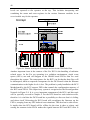
The data readout in ALICE is trigger based. This means that any collision will be
detected by a group of fast detectors that will notify a central trigger system. The
central trigger system will distribute triggers to the different sub-detectors to start
buffering and readout of data. When the data is read out, it is moved from buffers in
the readout electronics via an optical link to computer farms where further analysis is
done before the data is stored to disk. As the potential data rate from the readout
electronics sub-systems is approximately an order of magnitude higher than what can
be stored to disk, or even transmitted over the optical data links, data processing and
compressing are done by the readout electronics.
Because of the flexibility, the cost and the possibility to easily do future upgrades of
the electronics, it has been decided to make extensive use of commercial SRAM
based Field Programmable Gate Arrays (FPGAs) in the readout electronics. The other
side of the coin is that these devices are generally not very radiation tolerant. The
architecture of the ALICE detector is such that physically shielding of the electronics
is not possible, which impose challenges in designing the electronics. This implies
that the concern with radiation related errors need to be handled with other techniques
such as firmware mitigation techniques.
The radiation environment is not the only challenge when designing the readout
electronics. As the readout electronic devices are located directly on the detector
devices, they are physically unavailable as soon as the ALICE detector is fully
operative. It is vital that they are operated under stable temperatures and that if any