1
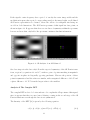
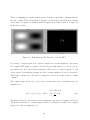
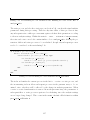
The 2D frequency spectrum represents sinusoidal components with sinusoidal amplitude
modulation. When the frequency of either the carrier or the modulator exactly matches
the centre frequency of one of the 2D spectrum points for its respective axis, the component
will be precisely modelled by a single bin in that axis. If the frequency of either carrier or
modulator doesn’t match the centre frequency of a 2D spectrum point, then its energy will
be spread across several bins along the respective axis. This energy smearing is the same
as in 1D Fourier analysis and might be solved using 2D implementations of the techniques
used to improve spectrum resolution in one dimension [12]. The centre frequency of the
points on both frequency axes of the 2D spectrum is defined by the width of the raster
image so an informed choice of raster image width has to be made based on signal analysis
in order to obtain a clear 2D spectrum.
4.4
Two-Dimensional Spectrum Display
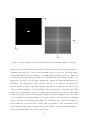
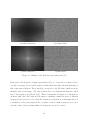
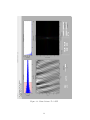
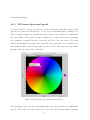
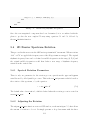
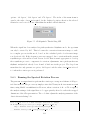
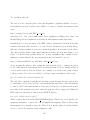
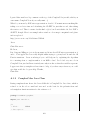
The 2D Fourier spectrum plot needed to represent the complex Fourier data matrix clearly,
allowing the user to take in a lot of information at once. Fourier data is more easily understood in the polar representation which is standard in 1D Fourier analysis, so the magnitude
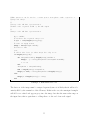
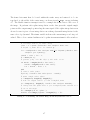
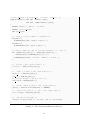
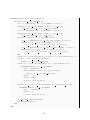
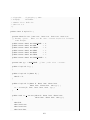
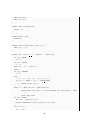
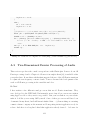
and phase components are extracted. The function calc spec2D, shown in listing 4.3 was
written to calculate the spectrum display data, from the complex Fourier data stored in
the FT cell array in the data structure. The Fourier transform data is first shifted using the
built-in fftshift function to place the DC component in the centre of the matrix. Then
the angle function returns the phase component and the abs function then returns the
magnitudes. The polar representation is converted to an RGB colour matrix as described
in section 4.4.1.
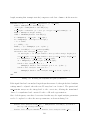
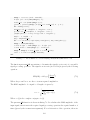
function r e t = c a l c s p e c 2 D (FT, b r i g h t n e s s , contrast , mode , ret mag )
%PLOT SPEC2D c a l c u l a t e s a 2D spectrum g i v e n t h e F o u r i e r t r a n s f o r m d a t a .
%
g e t t h e magnitude component ( c e n t r e d )
mag = abs ( f f t s h i f t (FT) ) ;
%
normalise
max mag = max(max(mag) ) ;
i f ret mag
r e t = max mag ;
70